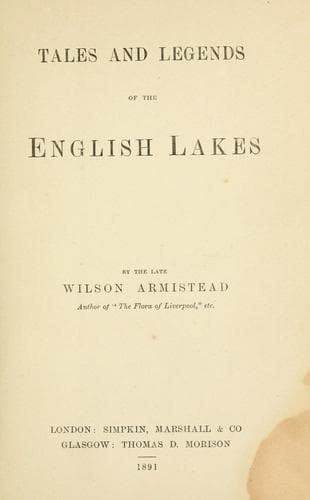
Tales and Legends of the English LakesArmistead, Wilson
General
Tales and Legends of the English Lakes
Armistead, Wilson
Folklore -- England -- Lake District; Legends -- England -- Lake District; Tales -- England -- Lake District
Though he was personally known in Cheshire to many of the
inhabitants, yet this specious hypocrite had so artfully disguised
himself, that he quitted the town without any suspicions before the
Bow Street officers reached that place in quest of him. He was then
traced to Brielth, in Brecknockshire, and was at length apprehended
about sixteen miles from Swansea, and committed to Brecon jail. He
had a cravat on, with his initials, J. H., which he attempted to
account for by calling himself John Henry.
Before the magistrates he declared himself to be Ludor Henry; and
in order to prepossess the honest Cambrians in his favour, boasted
that he was descended from an ancient family in Wales, for the
inhabitants of which country he had ever entertained a sincere
regard. He was, however, conveyed up to town by the Bow Street
officers, where he was examined on his arrival before the
magistrates. The solicitor for his bankruptcy attended to identify
his person, and stated, that the commission of bankruptcy was
issued against Hatfield in June, 1802; that he attended the last
meeting of the commissioners, but the prisoner did not appear,
although due notice had been given in the _Gazette_, and he himself
had given notice to the prisoner's wife, at Wakefield near
Tiverton, Devon. Mr. Parkyn, the solicitor to the Post-office,
produced a warrant from Sir Frederick Vane, Bart., a magistrate for
the county of Cumberland, against the prisoner, by the name of the
Hon. Alexander Augustus Hope, charging him with felony, by
pretending to be a member of parliament of the United Kingdom, and
franking several letters by the name of A. Hope, to several
persons, which were put into the Post-office at Keswick, in
Cumberland, in order to evade the duties of postage. Another charge
for forgery, and the charge for bigamy, were explained to him, but
not entered into, as he was committed for trial for these charges
at the next assizes at Carlisle. He conducted himself with the
greatest propriety during his journey to town, and on his
examination; but said nothing more than answering a few questions
put to him by Sir Richard Ford and the solicitors, affecting to
consider himself a persecuted individual, and representing, in
particular, that, in the alliance with Mary Robinson, he had been
rather sinned against than sinning. Mary, on the other hand, who
was now announced to be likely to bear a child to her pretended
husband, refused to become accessory to his prosecution. The utmost
she could be prevailed on to do against Hatfield was to address the
following letter to Sir Richard Ford:--
Public-domain text, read in full here on John Shaqi.
Reviews
Reviews
No reviews yet
Be the first to share your thoughts on this work.
Elsewhere in the archive
Join the Discussion
Join the discussion
Sign in to leave a comment or review.
Sign InorCreate an account