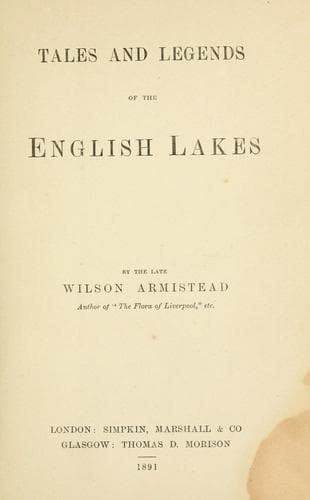
Tales and Legends of the English LakesArmistead, Wilson
General
Tales and Legends of the English Lakes
Armistead, Wilson
Folklore -- England -- Lake District; Legends -- England -- Lake District; Tales -- England -- Lake District
Charles Williams was one of those individuals who are "born to blush
unseen." It is probable, therefore, that his name is unknown, and that
his merits might have slept in obscurity but for us. We suspect that he
has never been heard of before, and it is very likely that he never will
be again. Charles had no long line of ancestors whose merits he could
impute to himself. His great-grandfather had, to be sure, been the most
noted wrestler in his day; and had annually won the belt at Bowness and
at Keswick, but his prowess was forgot by all but his immediate
descendants; and even his hard-earned belts had long since been cut up
for repairing cart gear. Though Charles was only the son of a small
farmer, yet there was one thing on which the family prided itself--there
was a W. W. over the kitchen door which
"Was a sartan sign," his mother argued, "et that hoos hed belengd to
them sometime lang sen."
There was one circumstance which we ought not to omit; particularly as
it excited no inconsiderable interest, at the time, through all the
neighbourhood of Kentmere. On the very day, and as far as we can
ascertain, at the very hour, when Charles was born, a huge stone,
self-moved, rolled down Wallow Crag into Hawes Water! The old women
could and would account for it no other way than that he was born to be
droond. Mr. Gough, who was then beginning to exhibit the first dawning
of that genius which has procured him the esteem and admiration of all
true lovers of rational philosophy, would gladly have convinced them
that it was nothing but the effects of a thaw which had taken place only
a few days before. But they argued that
"Thear hed been many a tha afoar, but niver a stane rolled doon Wallow
Crag afoar."
Charles however grew up to be a boy, just as if this ominous stone had
continued to sit secure on the mountain's ridge. But it might be said of
him that "a strange and wayward wight was he." While other boys were
ranging through the woods in pursuit of bird-nests, Charles would
stretch himself on a smooth-faced rock, and pore on the adjacent
landscape like one half crazed. To retire into a lonely wood behind his
father's house, and teach a little brook, which ran through it, to take
a thousand fantastic forms, was to Charles the sweetest recreation he
could enjoy. The perpetual wings of time had now spread fifteen or
sixteen winters over the vale of Kentmere, since the stone rolled into
Hawes Water, and Charles was grown a tall and graceful boy. The little
time which his father had spared him to school, had not been misemployed
by the active youth; and though he felt a diffidence about entering into
conversation, it was generally allowed that, when he did unloosen his
tongue, he could argue any man in the valley, except the parson, who
never stopt to hear anybody speak but himself, and the schoolmaster, who
never spoke at all.
Public-domain text, read in full here on John Shaqi.
Reviews
Reviews
No reviews yet
Be the first to share your thoughts on this work.
Join the Discussion
Join the discussion
Sign in to leave a comment or review.
Sign InorCreate an account