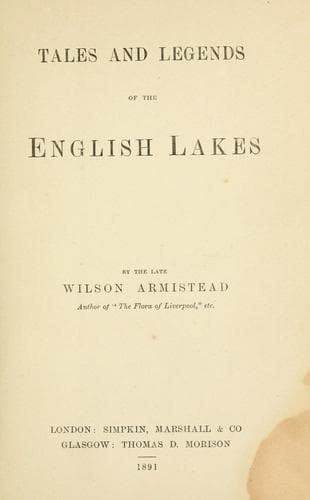
Tales and Legends of the English LakesArmistead, Wilson
General
Tales and Legends of the English Lakes
Armistead, Wilson
Folklore -- England -- Lake District; Legends -- England -- Lake District; Tales -- England -- Lake District
She even possessed a vivacity that accompanied all her actions, and
threw her real character into the distance. Though endued with the
keenest sensibility, she appeared all life and gaiety. Wherever she was,
she was the soul of the little company--her lively wit and her smiling
beauty procured her attention wherever she showed herself. This
beautiful mixture of the gay and the grave assumed, on some occasions,
such strange contrasts, that she seemed to be composed of
inconsistencies. Often in her little evening rambles with her young
companions, after having put them all in good humour with themselves and
with one another, by her little flattering railleries and harmless
frolics, she would in an instant bound away from the group with the
elastic grace of a mountain nymph--abruptly enter the cottage of some
sick or suffering neighbour, with a smile on her countenance, like the
angel of comfort charged with blessings, kindly inquire after their
various wants and distresses, soothe them with consolatory hopes of
better days, offer all those little assistances which old and decaying
age accepts so gratefully at the hands of youth, and after mingling a
sigh or a tear with theirs, again join her gay companions as though
nothing had occurred.
In the innocent society of this amiable maiden, Charles passed the
sweetest hours of his existence. His former boyish pursuits were
renounced. The windmill, on a rock at a little distance, though nearly
matured, was never completed; the water-works in the wood were permitted
to run to ruin, even the perpetual motion in the room over the old
kitchen, which was in a state of great forwardness, was neglected for a
time, and eventually relinquished.
It is supposed, our intelligent correspondent says, that if Charles had
never been in love, it is probable that he had never been a poet. And in
confirmation of this idea, we observe that his first productions are of
the amatory kind--"odes to beauty," "lines to Maria," "acrostics," &c.
Among these fragments, we found a little airy piece without a head but
we suppose intended for Maria:
"If all the world was made of kisses,
And all those kisses were made for me,
And I was made for you, my love,
How happy we should be!
If all the graces were join'd in one,
And all the wit and beauty too,
They'd make a maid like you, my love,
They'd make a maid like you!"
Some of his lyric pieces exhibit a strange mixture of philosophy and
passion, learning and love. In the eleventh page of the manuscript
before us, we find as curious a specimen of this kind as we ever
recollect. It is much interlined and seems never to have been finished.
ON LOVE.
"Newton's keen observant eye,
Found a power pervade creation;
Ignorant of when or why,
He fondly called it gravitation.
Public-domain text, read in full here on John Shaqi.
Reviews
Reviews
No reviews yet
Be the first to share your thoughts on this work.
Join the Discussion
Join the discussion
Sign in to leave a comment or review.
Sign InorCreate an account