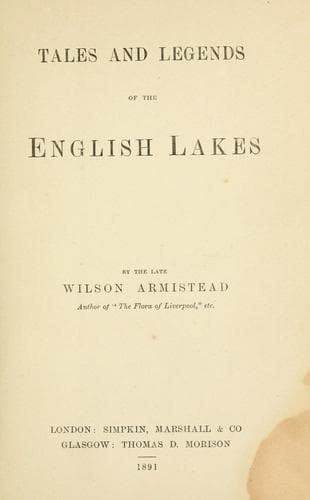
Tales and Legends of the English Lakes — John Shaqi
Tales and Legends of the English LakesArmistead, Wilson
General
Tales and Legends of the English Lakes
Armistead, Wilson
Folklore -- England -- Lake District; Legends -- England -- Lake District; Tales -- England -- Lake District
Our correspondent says he would be happy if he could here conclude his
narrative, as Sir Walter Scott does, with a happy marriage; for however
delightful the transition from sorrow to joy may be, the reverse, even
in description, has no charms. But poor Charles was doomed to be hurled
from the height of his felicity to the lowest depths of despair. The
joyful promise had scarcely escaped the lovely lips of Maria, and while
her lover was yet giddy with his joy, when the amiable maid was attacked
by a severe illness, which baffled all the doctor's skill. If entreaties
for human or divine aid could have prolonged the existence of the
ill-fated Maria, she had not died. Charles was ever at her pillow--his
studies were relinquished--his poetry was neglected--and the dying Maria
filled the whole extent of his capacious mind. But all was vain; the
grisly monster Death had selected her as his victim, and he would not
quit his hold; he was deaf alike to the lamentations of a parent, the
regrets of friends, and the distractions of a betrothed lover.
Though every succeeding morning showed how great was the havoc that
disease was making in her tender frame, and the period of her suffering
was evidently approaching, Charles still hoped she would soon be well.
If she was more than usually debilitated, he observed that the fever had
left her, and she only wanted her strength recruiting, and they would
then renew their walks. If the hectic flush overspread her cheeks, he
hailed it as the sign of returning health. And thus he hoped even
against hope. His reason would have convinced him she was dying, if
reason had been allowed to speak; but he wished her to live, and he
would not stoop to think that she would die. Thus he fulfilled the
remarks of the poet--
"We join in the fraud, and ourselves we deceive,
What we wish to be true, love bids us believe."
When at last the pale hue of death overspread her once-blooming cheek,
when she turned her languid eye towards her lover and faltered
"farewell," when she closed her faded eyes and expired in prayer,
Charles stood by the bedside like a being bereft of power and motion.
The deepest despair overwhelmed him--his hopes were blasted--his fond
creation of future bliss was in an instant destroyed, and his mind
received a shock too powerful for nature to sustain.
From this moment a smile was never seen to illuminate his features, the
most gloomy and secluded places were his favourite haunts. He avoided
society as if the breath of man was pestilential; and occupied his time
in brooding over his own melancholy. In his manuscript we find a number
of melancholy effusions, which were evidently written about this time;
and clearly bespeak a mind bordering on the gloomy verge of insanity.
But as they are some of them by far the best pieces in the collection--a
proof that poetry and madness are nearly allied--we will select two
which tend to illustrate the awful state of the writer's mind.
THE EVENING WALK.
Public-domain text, read in full here on John Shaqi.
Reviews
Reviews
No reviews yet
Be the first to share your thoughts on this work.
Join the Discussion
Join the discussion
Sign in to leave a comment or review.
Sign InorCreate an account