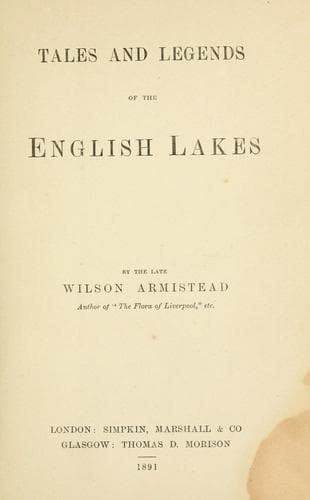
Tales and Legends of the English LakesArmistead, Wilson
General
Tales and Legends of the English Lakes
Armistead, Wilson
Folklore -- England -- Lake District; Legends -- England -- Lake District; Tales -- England -- Lake District
Nearer approach, however, dissipates this illusion. We lose sight of the
valley, being in it, and of the mountains, in the presence of immediate
objects. Tall chimneys rear their heads in considerable numbers, pouring
forth steam and smoke, and with square buildings and their numerous
windows, prove incontestably that modern Carlisle is a manufacturing
city, and has associations very different from those of its former
history. On entrance, the contrast between the past and the present
becomes still more vivid. We see that its walls and gates have
disappeared; that its streets are clean, wide and comfortable, which no
ancient streets in England ever were; and that it has altogether a
juvenile, busy, and thriving appearance, giving few signs (to the eye at
least) that it has been in existence above a century. It is true that
two venerable relics, its castle and its cathedral, remain to attest its
bygone grandeur and glory; but these are not immediately visible, and
have to be sought out by the enquiring stranger; whilst all around him
is modern and prosaic; and a mere reduplication of the same
characteristics of English life and manners that he must have seen in a
hundred other places.
Still, however, it is "merry Carlisle," and "bonnie Carlisle," although,
like all other mundane things, it has been changed by time; and is quite
as much King Arthur's city as England is King Arthur's England; and
brimfull of associations which the traveller will be at no loss to
recall, of the crime and sorrow--the "fierce wars and faithful loves" of
our ancestors, from the year 800 downwards to 1745. Not that Carlisle is
only a thousand years old. It has a much earlier origin than the year
800, having been founded by the Romans. By them it was called
Luguballium, or Luguvallum, signifying the tower or station by the wall,
and was so named from its contiguity to the wall of Severus. The Saxons,
disliking this long and awkward name, abbreviated it into Luel; and
afterwards in speaking of it, called it Caer-luel, or the city of Luel;
from whence comes its present designation of Carlisle. It is supposed to
have been during the Saxon period, if not the chief city, the frequent
residence of that great mythic personage, King Arthur, where he
With fifty good and able
Knights that resorted unto him
And were of his round table:
Did hold his jousts and tournaments,
Whereto were many pressed,
Wherein some knights did far excel
And eke surmount the rest.
Public-domain text, read in full here on John Shaqi.
Reviews
Reviews
No reviews yet
Be the first to share your thoughts on this work.
Join the Discussion
Join the discussion
Sign in to leave a comment or review.
Sign InorCreate an account