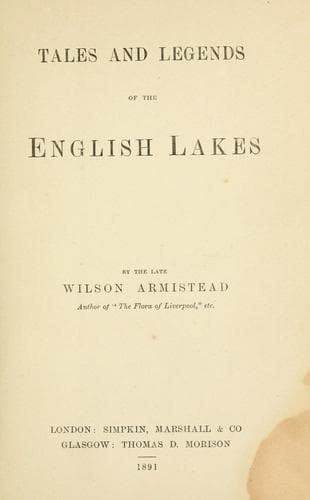
Tales and Legends of the English LakesArmistead, Wilson
General
Tales and Legends of the English Lakes
Armistead, Wilson
Folklore -- England -- Lake District; Legends -- England -- Lake District; Tales -- England -- Lake District
Her haires, like serpents, clung aboute
Her cheekes of deadlye hewe:
A worse-form'd ladye than she was,
No man mote ever viewe.
This ill-conditioned damsel tells him the secret, however, upon
condition that he will bring her a "fair and courtly knight to marry
her,"--a condition which, considering all the circumstances, must have
seemed to the good king as bad as the jumping out of the frying-pan into
the fire. The great secret is, as she expresses it, "that all women will
have their wille, and this is their chief desyre," which Arthur
forthwith tells to the "grimme baròne;" and so acquits himself as far as
he is concerned. The other trouble, however, still remains, and fills
the king's mind with anxiety. Queen Guinevere, who was outraged as well
as her husband by the opprobrious message of the "grimme baròne," but
who had never thought of the very obvious solution of the riddle he had
been set, comes out to meet him on his return, and inquires how he has
sped. He details his new tribulation in having promised to procure a
fair knight to marry this ugly, mis-shapen creature. Comfort is nearer
at hand than he thought, and Sir Gawaine, his own nephew, "his sister's
son," bids him "be merrye and lighte," for he will marry her, however
foul and loathsome she may be. He does so accordingly:--
And when they were in wed-bed laid,
And all were done awaye:
"Come turne to me, mine owne wed-lord,
Come turne to mee, I praye."
Sir Gawaine scant could lift his head,
For sorrowe and for care;
When lo! instead of that lothelye dame,
He sawe a young ladye faire.
Sweet blushes stayn'd her rud-red cheeke,
Her eyen were blacke as sloe;
The ripening cherrye swellde her lippe,
And all her necke was snowe.
Agreeably surprised at the change, Sir Gawaine soon learns to love the
lady. She informs him that, by a cruel fate, she cannot be fair both
night and day; and asks him which he prefers. He hints that the night
would be most pleasant; to which she replies:--
What when gaye ladyes goe with their lordes
To drinke the ale and wine;
Alas! then I must hide myself,
I must not go, with mine?
"My faire ladyè, Sir Gawaine sayd,
I yield me to thy skille;
Because thou art my owne ladye
Thou shalt have all thy wille."
The spell is broken. She tells him her history; and that henceforth she
shall be fair both night and day.
My father was an aged knighte,
And yet it chanced soe,
He took to wife a false ladyè,
Whiche broughte me to this woe.
Shee witch'd mee, being a faire younge maide,
In the grene forèst to dwelle;
And there to abide in lothlye shape,
Most like a fiend of helle.
Midst mores and mosses, woods, and wilds;
To lead a lonesome life:
Till some yonge faire and courtlye knighte
Wolde marrye me for his wife:
Public-domain text, read in full here on John Shaqi.
Reviews
Reviews
No reviews yet
Be the first to share your thoughts on this work.
Join the Discussion
Join the discussion
Sign in to leave a comment or review.
Sign InorCreate an account