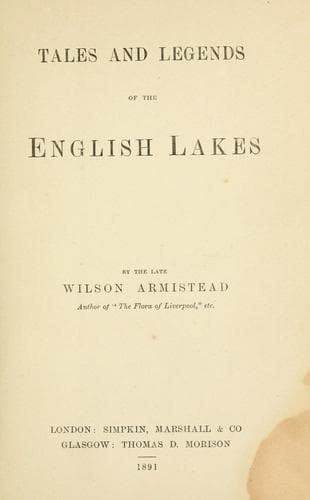
Tales and Legends of the English LakesArmistead, Wilson
General
Tales and Legends of the English Lakes
Armistead, Wilson
Folklore -- England -- Lake District; Legends -- England -- Lake District; Tales -- England -- Lake District
The lady of Sir Kay, another of King Arthur's knights, tries it on with
no better success; and the ballad thus corroborates the old traditions
reported by the earliest historians, that the court of the British King
was anything but a pure one, "and that Queen Guinevere was noted for
breach of faith to her husband," especially with her husband's friend,
Sir Lancelot du Lake, the hero himself of many a goodly ballad; and of
some passages in the Morte Arthur.
Mixing the real with the fabulous history of Carlisle, and taking both
in chronological order, we must leave these ancient ballads to relate
that, during the period of the British Kings, Carlisle suffered from the
incursions of the Scots and Picts, by whom it was ultimately reduced to
ruins; it was rebuilt by Egfrid, King of Northumberland, who surrounded
and fortified it with a wall; founded a monastery and a college of
secular priests. It was once more destroyed by the Danes, about the
year 900, who threw down the walls, burned its houses, chiefly built of
wood, and killed every person in it, man, woman, and child. It remained
in ruins, it is believed, for nearly 200 years. On the return of William
Rufus from Alnwick, after concluding a peace with the turbulent Scotch,
he passed over the remains of this once celebrated city, and observing
that it must have been a place of great strength, and could be made so
again, he resolved to rebuild it for the protection of the border. He
did so: and Carlisle became of more importance than it had ever been
before. Its castle was built and garrisoned; and every means taken to
render it a stronghold both for offensive and defensive warfare. Henry
the First completed what Rufus had so well begun, erected Carlisle into
an Episcopal see in the year 1132, making Athelwold, his confessor, the
first bishop.
In Evans's Collection of Old Ballads is one relating to a bishop of
Carlisle at this early period. It is entitled "Bishop Thurston and the
King of Scots," and contains some beautiful passages which render it
worthy of all the publicity that can be given to it; especially as the
whole composition inculcates sentiments of abhorrence for warfare, rare
at the time it was penned, but now, happily, in the ascendant. Soon
after King Stephen's departure for Normandy, A.D. 1137, the King of
Scotland entered England in a hostile manner. Stephen's Government was
not in a position to resist an invasion at that time; and the miseries
of war were averted by the interposition of the venerable Bishop
Thurston, who prevailed upon the Scotch King to meet him at Roxburgh,
and used such arguments as induced him to return to his own country in
peace. They are said to have been arguments of Christian charity, and
not the arguments of policy and the sword, which bishops as well as
barons could use in those days. A few stanzas will show the excellent
spirit of the ballad.
Public-domain text, read in full here on John Shaqi.
Reviews
Reviews
No reviews yet
Be the first to share your thoughts on this work.
Join the Discussion
Join the discussion
Sign in to leave a comment or review.
Sign InorCreate an account