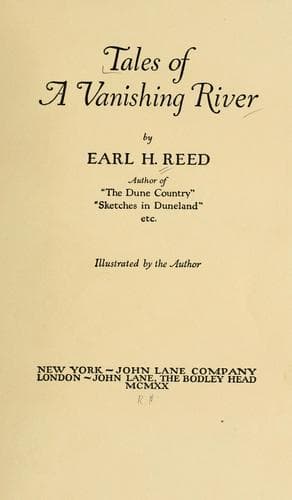
Tales of a Vanishing RiverReed, Earl H. (Earl Howell)
History
Tales of a Vanishing River
Reed, Earl H. (Earl Howell)
Illinois -- Social life and customs -- Fiction; Kankakee River (Ind. and Ill.) -- Fiction; Short stories, American
“Every female eye was uninterruptedly focussed on this striking looking
man during the entire hearing. He was claimed to be the same stranger
who had blown open the safe and abstracted the seven thousand dollars of
the county’s money. The loss will of course have to be made good by the
treasurer or his bondsmen, if the plunder is not recovered from the
thief, and much sympathy is felt for the Hon. Truman W. Pettibone, who
has long borne an enviable and unsullied reputation in our midst.
“Several of the ladies present were to appear among the witnesses in
behalf of the state and for the defense. The question under
consideration was the identity of this tall mysterious looking prisoner
and that tall disguised stranger who was unquestionably responsible
before the law for the astounding burglary.
“The counsel for the state was the Hon. John Wesley Watts, our brilliant
and alert county attorney. The prisoner was represented by W. St. John
Hopkins, whose very name smacks of irreverence for the Holy Writ. He is
a young aspiring sprig of the law who has recently come into our midst.
“It seems that this man Hopkins, who parts both his name and his hair in
the middle, volunteered to defend the prisoner without compensation,
probably for the purpose of showing off his talents. The prisoner was
without counsel, and claimed to have no funds with which to hire one.
They seemed to be suspiciously good friends in court. Whether or not a
part of the loot from the exploded safe has covertly changed hands in
payment for certain legal services during the past few days, it is not
within the province of this paper to determine, or even hint.
“The examination continued during Wednesday and Thursday, excellent
order prevailing in the court room. Many citizens gave strong testimony
both for and against the prisoner. The public were deeply interested in
the solution of the question, and there were strong and conflicting
opinions as to the identity of the prisoner in the minds of all present.
The progress of the examination, as numerous witnesses were examined who
had seen the prowling and disguised stranger, and who now saw the
prisoner, brought distinctly to notice the great difference which exists
in the observing power of different individuals. Many thought that if
the prisoner had on a gray coat, and had a long chin beard, in addition
to his moustache, they could absolutely swear to his identity. Others
thought that the stranger had worn false whiskers and had particularly
noticed it at the time.
“J. Milton Tuttle did not think that the chin whiskers were false, or
that the prisoner was the man who left the tin box for safe keeping. He
was quite positive that he would recognize the man if he ever saw him
again.
Public-domain text, read in full here on John Shaqi.
Reviews
Reviews
No reviews yet
Be the first to share your thoughts on this work.
Elsewhere in the archive
Join the Discussion
Join the discussion
Sign in to leave a comment or review.
Sign InorCreate an account