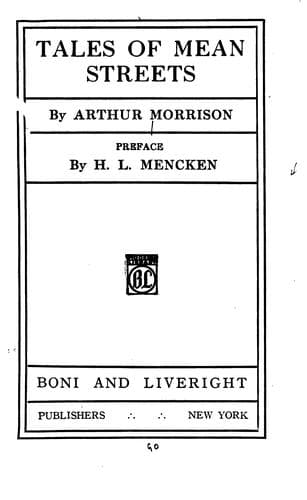
East End (London, England) -- Fiction; London (England) -- Social life and customs -- Fiction
"Of course it's fair," Simmons replied effusively. "It's more'n fair:
it's noble--downright noble, _I_ call it. But I ain't goin' to take a
mean advantage o' your good-'artedness, Mr. Ford. She's your wife, an' I
oughtn't to 'a' come between you. I apologize. You stop an' 'ave yer
proper rights. It's me as ought to shunt, an' I will." And he made a
step toward the door.
"'Old on," quoth Ford, and got between Simmons and the door; "don't do
things rash. Look wot a loss it'll be to you with no 'ome to go to, an'
nobody to look after ye, an' all that. It'll be dreadful. Say a
couple--there, we won't quarrel, jest a single quid, between man an'
man, an' I'll stand a pot out o' the money. You can easy raise a
quid--the clock 'ud pretty nigh do it. A quid does it; an' I'll--"
There was a loud double-knock at the front door. In the East End a
double-knock is always for the upstairs lodgers.
"Oo's that?" asked Bob Ford apprehensively.
"I'll see," said Thomas Simmons in reply, and he made a rush for the
staircase.
Bob Ford heard him open the front door. Then he went to the window, and,
just below him, he saw the crown of a bonnet. It vanished, and borne to
him from within the door there fell upon his ear the sound of a
well-remembered female voice.
"Where ye goin' now with no 'at?" asked the voice sharply.
"Awright, 'Anner--there's--there's somebody upstairs to see you,"
Simmons answered. And, as Bob Ford could see, a man went scuttling down
the street in the gathering dusk. And behold, it was Thomas Simmons.
Ford reached the landing in three strides. His wife was still at the
front door, staring after Simmons. He flung into the back room, threw
open the window, dropped from the wash-house roof into the back-yard,
scrambled desperately over the fence, and disappeared into the gloom. He
was seen by no living soul. And that is why Simmons's base
desertion--under his wife's very eyes, too--is still an astonishment to
the neighbors.
BEHIND THE SHADE.
The street was the common East End street--two parallels of brick
pierced with windows and doors. But at the end of one, where the builder
had found a remnant of land too small for another six-roomer, there
stood an odd box of a cottage, with three rooms and a wash-house. It had
a green door with a well-blacked knocker round the corner; and in the
lower window in front stood a "shade of fruit"--a cone of waxen grapes
and apples under a glass cover.
Public-domain text, read in full here on John Shaqi.
Reviews
Reviews
No reviews yet
Be the first to share your thoughts on this work.
Join the Discussion
Join the discussion
Sign in to leave a comment or review.
Sign InorCreate an account