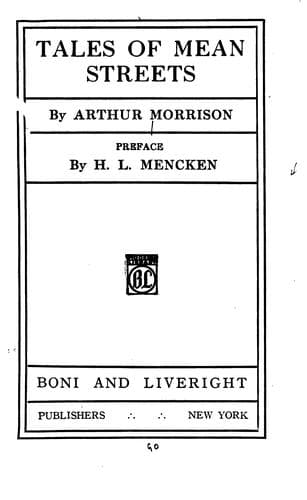
East End (London, England) -- Fiction; London (England) -- Social life and customs -- Fiction
The house had been "genteel." When trade was prospering in the East End,
and the ship-fitter or block-maker thought it no shame to live in the
parish where his workshop lay, such a master had lived here. Now, it was
a tall, solid, well-bricked, ugly house, grimy and paintless in the
joinery, cracked and patched in the windows: where the front door stood
open all day long; and the womankind sat on the steps, talking of
sickness and deaths and the cost of things; and treacherous holes lurked
in the carpet of road-soil on the stairs and in the passage. For when
eight families live in a house, nobody buys a door-mat, and the street
was one of those streets that are always muddy. It smelt, too, of many
things, none of them pleasant (one was fried fish); but for all that it
was not a slum.
Three flights up, a gaunt woman with bare forearms stayed on her way to
listen at a door which, opening, let out a warm, fetid waft from a close
sick-room. A bent and tottering old woman stood on the threshold,
holding the door behind her.
"An' is 'e no better now, Mrs. Curtis?" the gaunt woman asked, with a
nod at the opening.
The old woman shook her head, and pulled the door closer. Her jaw
waggled loosely in her withered chaps: "Nor won't be; till 'e's gone."
Then after a certain pause, "'E's goin'," she said.
"Don't doctor give no 'ope?"
"Lor' bless ye, I don't want to ast no doctors," Mrs. Curtis replied,
with something not unlike a chuckle. "I've seed too many on 'em. The
boy's a-goin', fast; I can see that. An' then"--she gave the handle
another tug, and whispered--"he's been called." She nodded amain. "Three
seprit knocks at the bed-head las' night; an' I know what _that_ means!"
The gaunt woman raised her brows, and nodded. "Ah, well," she said, "we
all on us comes to it some day, sooner or later. An' it's often a 'appy
release."
The two looked into space beyond each other, the elder with a nod and a
croak. Presently the other pursued, "'E's been a very good son, ain't
'e?"
"Ay, ay, well enough son to me," responded the old woman, a little
peevishly; "an' I'll 'ave 'im put away decent, though there's on'y the
Union for me after. I can do that, thank Gawd!" she added, meditatively,
as chin on fist she stared into the thickening dark over the stairs.
"When I lost my pore 'usband," said the gaunt woman, with a certain
brightening, "I give 'im a 'ansome funeral. 'E was a Oddfeller, an' I
got twelve pound. I 'ad a oak caufin an' a open 'earse. There was a
kerridge for the fam'ly an' one for 'is mates--two 'orses each, an'
feathers, an' mutes; an' it went the furthest way round to the cimitry.
'Wotever 'appens, Mrs. Manders,' says the undertaker, 'you'll feel as
you're treated 'im proper; nobody can't reproach you over that.' An'
they couldn't. 'E was a good 'usband to me, an' I buried 'im
respectable."
Public-domain text, read in full here on John Shaqi.
Reviews
Reviews
No reviews yet
Be the first to share your thoughts on this work.
Elsewhere in the archive
Join the Discussion
Join the discussion
Sign in to leave a comment or review.
Sign InorCreate an account