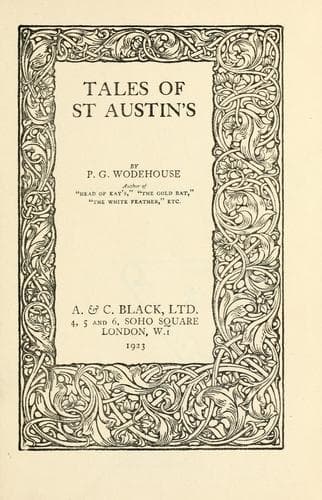
Tales of St. Austin'sWodehouse, P. G. (Pelham Grenville)
General
Tales of St. Austin's
Wodehouse, P. G. (Pelham Grenville)
Humorous stories; Schools -- Fiction
This was a plain and uninteresting statement of fact, and appeared to
me to require no answer. I read on.
'Fine book, sir.'
'Very.'
'I suppose you have heard of the Tom Brown Question?'
I shut my book wearily, and said I had not.
'It is similar to the Homeric Question. You have heard of that, I
suppose?'
I knew that there was a discussion about the identity of the author of
the Iliad. When at school I had been made to take down notes on the
subject until I had grown to loathe the very name of Homer.
'You see,' went on my companion, 'the difficulty about _Tom Brown's
Schooldays_ is this. It is obvious that part one and part two were
written by different people. You admit that, I suppose?'
'I always thought Mr Hughes wrote the whole book.'
'Dear me, not really? Why, I thought everyone knew that he only wrote
the first half. The question is, who wrote the second. I know, but I
don't suppose ten other people do. No, sir.'
'What makes you think he didn't write the second part?'
'My dear sir, just read it. Read part one carefully, and then read part
two. Why, you can see in a minute.'
I said I had read the book three times, but had never noticed anything
peculiar about it, except that the second half was not nearly so
interesting as the first.
'Well, just tell me this. Do you think the same man created East and
Arthur? Now then.'
I admitted that it was difficult to understand such a thing.
'There was a time, of course,' continued my friend, 'when everybody
thought as you do. The book was published under Hughes's name, and it
was not until Professor Burkett-Smith wrote his celebrated monograph on
the subject that anybody suspected a dual, or rather a composite,
authorship. Burkett-Smith, if you remember, based his arguments on two
very significant points. The first of these was a comparison between
the football match in the first part and the cricket match in the
second. After commenting upon the truth of the former description, he
went on to criticize the latter. Do you remember that match? You do?
Very well. You recall how Tom wins the toss on a plumb wicket?'
'Yes.'
'Then with the usual liberality of young hands (I quote from the book)
he put the M.C.C. in first. Now, my dear sir, I ask you, would a school
captain do that? I am young, says one of Gilbert's characters, the
Grand Duke, I think, but, he adds, I am not so young as that. Tom may
have been young, but would he, _could_ he have been young enough
to put his opponents in on a true wicket, when he had won the toss?
Would the Tom Brown of part one have done such a thing?'
'Never,' I shouted, with enthusiasm.
'But that's nothing to what he does afterwards. He permits, he actually
sits there and permits, comic songs and speeches to be made during the
luncheon interval. Comic Songs! Do you hear me, sir? COMIC SONGS!! And
this when he wanted every minute of time he could get to save the
match. Would the Tom Brown of part one have done such a thing?'
Public-domain text, read in full here on John Shaqi.
Reviews
Reviews
No reviews yet
Be the first to share your thoughts on this work.
Elsewhere in the archive
Join the Discussion
Join the discussion
Sign in to leave a comment or review.
Sign InorCreate an account