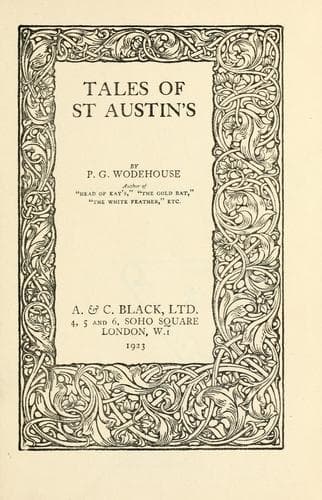
Tales of St. Austin'sWodehouse, P. G. (Pelham Grenville)
General
Tales of St. Austin's
Wodehouse, P. G. (Pelham Grenville)
Humorous stories; Schools -- Fiction
Jenkins was equally a bosom friend, and in the matter of wisdom in no
way inferior to Peterson.
'What would happen, do you think?' asked Babington.
'Sack,' said one authority.
'Jaw, and double impot,' said another.
'The _Daily Telegraph_,' muttered the tempter in a stage aside,
'calls it the best comedy since Sheridan.'
'So it does,' thought Babington. 'I'll risk it.'
'You'll be a fool if you do,' croaked the gloomy Jenkins. 'You're bound
to be caught.' But the Ayes had it. Babington wrote off that night
accepting the invitation.
It was with feelings of distinct relief that he heard Mr Seymour
express to another master his intention of catching the twelve-fifteen
train up to town. It meant that he would not be on the scene to see him
start on the 'Hall and Knight'. Unless luck were very much against him,
Babington might reasonably hope that he would accept the imposition
without any questions. He had taken the precaution to get the examples
finished overnight, with the help of Peterson and Jenkins, aided by a
weird being who actually appeared to like algebra, and turned out ten
of the twenty problems in an incredibly short time in exchange for a
couple of works of fiction (down) and a tea (at a date). He himself
meant to catch the one-thirty, which would bring him to town in good
time. Peterson had promised to answer his name at roll-call, a delicate
operation, in which long practice had made him, like many others of the
junior members of the House, no mean proficient.
It would be pleasant for a conscientious historian to be able to say
that the one-thirty broke down just outside Victoria, and that
Babington arrived at the theatre at the precise moment when the curtain
fell and the gratified audience began to stream out. But truth, though
it crush me. The one-thirty was so punctual that one might have thought
that it belonged to a line other than the line to which it did belong.
From Victoria to Charing Cross is a journey that occupies no
considerable time, and Babington found himself at his destination with
five minutes to wait. At twenty past his cousin arrived, and they made
their way to the theatre. A brief skirmish with a liveried menial in
the lobby, and they were in their seats.
Some philosopher, of extraordinary powers of intuition, once informed
the world that the best of things come at last to an end. The statement
was tested, and is now universally accepted as correct. To apply the
general to the particular, the play came to an end amidst uproarious
applause, to which Babington contributed an unstinted quotum, about
three hours after it had begun.
'What do you say to going and grubbing somewhere?' asked Babington's
cousin, as they made their way out.
Public-domain text, read in full here on John Shaqi.
Reviews
Reviews
No reviews yet
Be the first to share your thoughts on this work.
Elsewhere in the archive
Join the Discussion
Join the discussion
Sign in to leave a comment or review.
Sign InorCreate an account