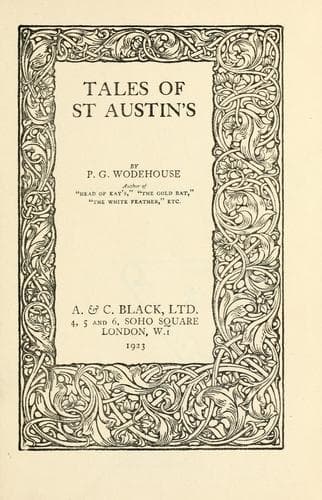
Tales of St. Austin'sWodehouse, P. G. (Pelham Grenville)
General
Tales of St. Austin's
Wodehouse, P. G. (Pelham Grenville)
Humorous stories; Schools -- Fiction
'Hullo, there's that man Richards,' he continued, before Babington
could reply that of all possible actions he considered that of going
and grubbing somewhere the most desirable. 'Fellow I know at Guy's, you
know,' he added, in explanation. 'I'll get him to join us. You'll like
him, I expect.'
Richards professed himself delighted, and shook hands with Babington
with a fervour which seemed to imply that until he had met him life had
been a dreary blank, but that now he could begin to enjoy himself
again. 'I should like to join you, if you don't mind including a friend
of mine in the party,' said Richards. 'He was to meet me here. By the
way, he's the author of that new piece--_The Way of the World.'_
'Why, we've just been there.'
'Oh, then you will probably like to meet him. Here he is.'
As he spoke a man came towards them, and, with a shock that sent all
the blood in his body to the very summit of his head, and then to the
very extremities of his boots, Babington recognized Mr Seymour. The
assurance of the programme that the play was by Walter Walsh was a
fraud. Nay worse, a downright and culpable lie. He started with the
vague idea of making a rush for safety, but before his paralysed limbs
could be induced to work, Mr Seymour had arrived, and he was being
introduced (oh, the tragic irony of it) to the man for whose benefit he
was at that very moment supposed to be working out examples three
hundred to three-twenty in 'Hall and Knight'.
Mr Seymour shook hands, without appearing to recognize him. Babington's
blood began to resume its normal position again, though he felt that
this seeming ignorance of his identity might be a mere veneer, a wile
of guile, as the bard puts it. He remembered, with a pang, a story in
some magazine where a prisoner was subjected to what the light-hearted
inquisitors called the torture of hope. He was allowed to escape from
prison, and pass guards and sentries apparently without their noticing
him. Then, just as he stepped into the open air, the chief inquisitor
tapped him gently on the shoulder, and, more in sorrow than in anger,
reminded him that it was customary for condemned men to remain
_inside_ their cells. Surely this was a similar case. But then the
thought came to him that Mr Seymour had only seen him once, and so
might possibly have failed to remember him, for there was nothing
special about Babington's features that arrested the eye, and stamped
them on the brain for all time. He was rather ordinary than otherwise
to look at. At tea, as bad luck would have it, the two sat opposite one
another, and Babington trembled. Then the worst happened. Mr Seymour,
who had been looking attentively at him for some time, leaned forward
and said in a tone evidently devoid of suspicion: 'Haven't we met
before somewhere? I seem to remember your face.'
'Er--no, no,' replied Babington. 'That is, I think not. We may have.'
'I feel sure we have. What school are you at?'
Babington's soul began to writhe convulsively.
Public-domain text, read in full here on John Shaqi.
Reviews
Reviews
No reviews yet
Be the first to share your thoughts on this work.
Elsewhere in the archive
Join the Discussion
Join the discussion
Sign in to leave a comment or review.
Sign InorCreate an account