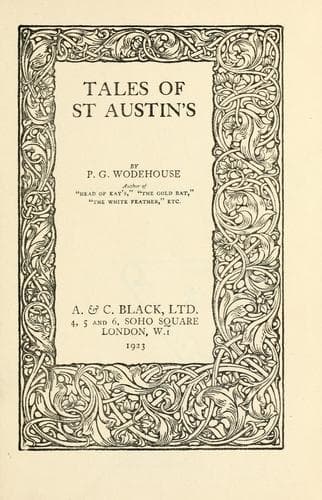
Tales of St. Austin'sWodehouse, P. G. (Pelham Grenville)
General
Tales of St. Austin's
Wodehouse, P. G. (Pelham Grenville)
Humorous stories; Schools -- Fiction
The papers sometimes contain humorous forecasts of future education,
when cricket and football shall come to their own. They little know the
excellence of the thing they mock at. When we get schools that teach
nothing but games, then will the sun definitely refuse to set on the
roast beef of old England. May it be soon. Some day, mayhap, I shall
gather my great-great-grandsons round my knee, and tell them--as one
tells tales of Faery--that I can remember the time when Work was
considered the be-all and the end-all of a school career. Perchance,
when my great-great-grandson John (called John after the famous Jones
of that name) has brought home the prize for English Essay on 'Rugby
_v._ Association', I shall pat his head (gently) and the tears
will come to my old eyes as I recall the time when I, too, might have
won a prize--for that obsolete subject, Latin Prose--and was only
prevented by the superior excellence of my thirty-and-one fellow
students, coupled, indeed, with my own inability to conjugate
_sum._
Such days, I say, may come. But now are the Dark Ages. The only thing
that can possibly make Work anything but an unmitigated nuisance is the
prospect of a 'Varsity scholarship, and the thought that, in the event
of failure, a 'Varsity career will be out of the question.
With this thought constantly before him, the student can put a certain
amount of enthusiasm into his work, and even go to the length of rising
at five o'clock o' mornings to drink yet deeper of the cup of
knowledge. I have done it myself. 'Varsity means games and yellow
waistcoats and Proctors, and that sort of thing. It is worth working
for.
But for the unfortunate individual who is barred by circumstances from
participating in these joys, what inducement is there to work? Is such
a one to leave the school nets in order to stew in a stuffy room over a
Thucydides? I trow not.
Chapter one of my great forthcoming work, _The Compleat Slacker_,
contains minute instructions on the art of avoiding preparation from
beginning to end of term. Foremost among the words of advice ranks this
maxim: Get an official list of the books you are to do, and examine
them carefully with a view to seeing what it is possible to do unseen.
Thus, if Virgil is among these authors, you can rely on being able to
do him with success. People who ought to know better will tell you that
Virgil is hard. Such a shallow falsehood needs little comment. A
scholar who cannot translate ten lines of _The Aeneid_ between the
time he is put on and the time he begins to speak is unworthy of pity
or consideration, and if I meet him in the street I shall assuredly cut
him. Aeschylus, on the other hand, is a demon, and needs careful
watching, though in an emergency you can always say the reading is
wrong.
Public-domain text, read in full here on John Shaqi.
Reviews
Reviews
No reviews yet
Be the first to share your thoughts on this work.
Elsewhere in the archive
Join the Discussion
Join the discussion
Sign in to leave a comment or review.
Sign InorCreate an account