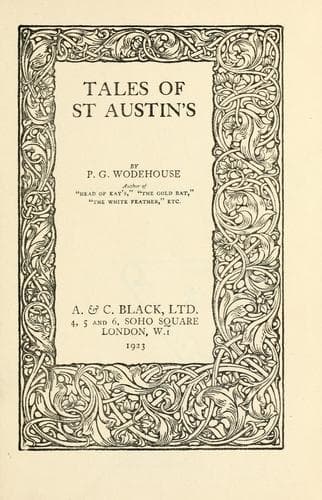
Tales of St. Austin'sWodehouse, P. G. (Pelham Grenville)
General
Tales of St. Austin's
Wodehouse, P. G. (Pelham Grenville)
Humorous stories; Schools -- Fiction
These voluminous notes are apt to prove a nuisance in more ways than
one. Your average master is generally inordinately fond of them, and
will frequently ask some member of the form to read his note on
so-and-so out to his fellows. This sometimes leads to curious results,
as it is hardly to be expected that the youth called upon will be
attending, even if he is awake, which is unlikely. On one occasion
an acquaintance of mine, 'whose name I am not at liberty to divulge',
was suddenly aware that he was being addressed, and, on giving the
matter his attention, found that it was the form-master asking him to
read out his note on _Balbus murum aedificavit_. My friend is a
kind-hearted youth and of an obliging disposition, and would willingly
have done what was asked of him, but there were obstacles, first and
foremost of which ranked the fact that, taking advantage of his
position on the back desk (whither he thought the basilisk eye of
Authority could not reach), he had substituted _Bab Ballads_ for
the words of Virgil, and was engrossed in the contents of that modern
classic. The subsequent explanations lasted several hours. In fact, it
is probable that the master does not understand the facts of the case
thoroughly even now. It is true that he called him a 'loathsome, slimy,
repulsive toad', but even this seems to fall short of the grandeur of
the situation.
Those notes, also, which are, alas! only too common nowadays, that deal
with peculiarities of grammar, how supremely repulsive they are! It is
impossible to glean any sense from them, as the Editor mixes up
Nipperwick's view with Sidgeley's reasoning and Spreckendzedeutscheim's
surmise with Donnerundblitzendorf's conjecture in a way that seems to
argue a thorough unsoundness of mind and morals, a cynical insanity
combined with a blatant indecency. He occasionally starts in a
reasonable manner by giving one view as (1) and the next as (2). So far
everyone is happy and satisfied. The trouble commences when he has
occasion to refer back to some former view, when he will say: 'Thus we
see (1) and (14) that,' etc. The unlucky student puts a finger on the
page to keep the place, and hunts up view one. Having found this, and
marked the spot with another finger, he proceeds to look up view
fourteen. He places another finger on this, and reads on, as follows:
'Zmpe, however, maintains that Schrumpff (see 3) is practically insane,
that Spleckzh (see 34) is only a little better, and that Rswkg (see 97
a (b) C3) is so far from being right that his views may be dismissed as
readily as those of Xkryt (see 5x).' At this point brain-fever sets in,
the victim's last coherent thought being a passionate wish for more
fingers. A friend of mine who was the wonder of all who knew him, in
that he was known to have scored ten per cent in one of these papers on
questions like the above, once divulged to an interviewer the fact that
he owed his success to his methods of learning rather than to his
ability.
Public-domain text, read in full here on John Shaqi.
Reviews
Reviews
No reviews yet
Be the first to share your thoughts on this work.
Elsewhere in the archive
Join the Discussion
Join the discussion
Sign in to leave a comment or review.
Sign InorCreate an account