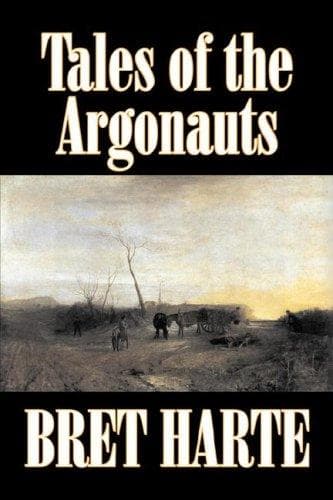
American fiction -- 19th century; Short stories; Western stories
Either there was something irresistibly conclusive in this logic, or
else the desire to hear the remainder of Plunkett's story was stronger;
but there was no more interruption. His ready good-humor quickly
returned, and, with a slight chuckle, he went on,--
“I went to the biggest jewelry shop in town, and I bought a pair of
diamond ear-rings, and put them in my pocket, and went to the house.
'What name?' says the chap who opened the door; and he looked like a
cross 'twixt a restaurant waiter and a parson. 'Skeesicks,' said I. He
takes me in; and pretty soon my wife comes sailin' into the parlor,
and says, 'Excuse me; but I don't think I recognize the name.' She was
mighty polite; for I had on a red wig and side-whiskers. 'A friend of
your husband's from California, ma'am, with a present for your daughter,
Miss--,' and I made as I had forgot the name. But all of a sudden a
voice said, 'That's too thin;' and in walked Melindy. 'It's playin' it
rather low down, father, to pretend you don't know your daughter's name;
ain't it, now? How are you, old man?' And with that she tears off my wig
and whiskers, and throws her arms around my neck--instinct, sir, pure
instinct!”
Emboldened by the laughter which followed his description of the filial
utterances of Melinda, he again repeated her speech, with more or less
elaboration, joining in with, and indeed often leading, the hilarity
that accompanied it, and returning to it, with more or less incoherency,
several times during the evening.
And so, at various times and at various places, but chiefly in
bar-rooms, did this Ulysses of Monte Flat recount the story of his
wanderings. There were several discrepancies in his statement; there was
sometimes considerable prolixity of detail; there was occasional change
of character and scenery; there was once or twice an absolute change in
the denoument: but always the fact of his having visited his wife and
children remained. Of course, in a sceptical community like that of
Monte Flat,--a community accustomed to great expectation and small
realization,--a community wherein, to use the local dialect, “they
got the color, and struck hardpan,” more frequently than any other
mining-camp,--in such a community, the fullest credence was not given
to old man Plunkett's facts. There was only one exception to the
general unbelief,--Henry York of Sandy Bar. It was he who was always
an attentive listener; it was his scant purse that had often furnished
Plunkett with means to pursue his unprofitable speculations; it was to
him that the charms of Melinda were more frequently rehearsed; it was he
that had borrowed her photograph; and it was he that, sitting alone in
his little cabin one night, kissed that photograph, until his honest,
handsome face glowed again in the firelight.
Public-domain text, read in full here on John Shaqi.
Reviews
Reviews
No reviews yet
Be the first to share your thoughts on this work.
Join the Discussion
Join the discussion
Sign in to leave a comment or review.
Sign InorCreate an account