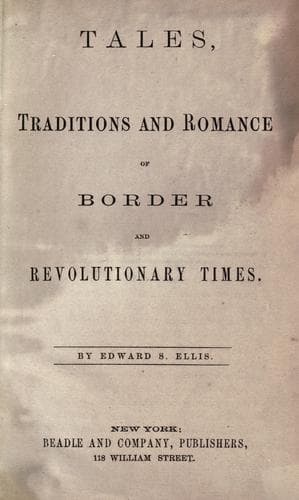
Tales, Traditions and Romance of Border and Revolutionary TimesEllis, Edward Sylvester
History
Tales, Traditions and Romance of Border and Revolutionary Times
Ellis, Edward Sylvester
Frontier and pioneer life -- United States -- Anecdotes; United States -- History -- Revolution, 1775-1783 -- Anecdotes
The officers present made no serious attempt to relieve their prisoner
from his predicament. They felt that he richly merited the castigation;
while the crestfallen General was too well assured of their feelings
toward him to reproach them—but he took a terrible revenge, when, after
a time, being exchanged, he returned to his command at Newport, where he
burned the towns and villages, turning the inhabitants houseless upon
the world. He never forgot or forgave this infliction of personal
punishment; and when, upon a subsequent occasion, three of the citizens
of Newport waited upon him concerning the business of the town, he
stormed and raved at one of them in such a manner that he was compelled
to withdraw. After the others had announced their business, and the
General had become somewhat calm, he inquired:
"Was not my treatment of Folger rather uncivil?"
Upon being assured that it certainly was, he explained it, by remarking:
"He looked so much like a —— Connecticut man, who horsewhipped me once,
that I could not bear the sight of him."
The accounts which are given of General Prescott's treatment of Ethan
Allen, are no more to the credit of his dignity than the story of the
succotash.
Shortly after Ethan Allen's celebrated conquest of Ticonderoga, he
joined the expedition into Canada, under Generals Schuyler and
Montgomery. He had no commission from Congress, but was induced by the
commanding officers to follow the army, under a promise that he should
command certain detachments in the army, when occasion required. He was
dispatched into Canada with letters to the Canadians, explaining the
object of the expedition, which was not aimed against the inhabitants of
the country, their liberties or religion, but against the British
possessors. The Canadians were invited to make common cause with the
Continentals, and expel the invader. His message was partially
successful, and numbers of the Canadians joined the Congressional
banner.
On a second expedition of a similar nature, he was induced to undertake
the enterprise against Montreal. Matters promised him success, but at a
critical moment many of his Canadian allies abandoned him. The result
was a total defeat, which ended in the surrender of himself and party.
Public-domain text, read in full here on John Shaqi.
Reviews
Reviews
No reviews yet
Be the first to share your thoughts on this work.
Elsewhere in the archive
Join the Discussion
Join the discussion
Sign in to leave a comment or review.
Sign InorCreate an account