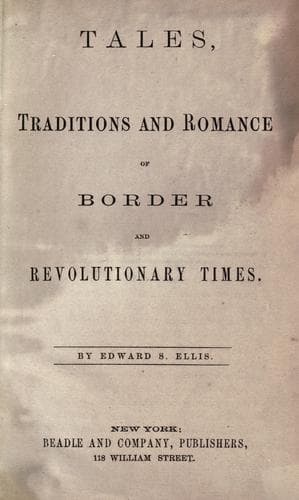
Tales, Traditions and Romance of Border and Revolutionary TimesEllis, Edward Sylvester
History
Tales, Traditions and Romance of Border and Revolutionary Times
Ellis, Edward Sylvester
Frontier and pioneer life -- United States -- Anecdotes; United States -- History -- Revolution, 1775-1783 -- Anecdotes
There was a kind of stratagem used in this contest, which was more than
once practiced by the experienced Virginia riflemen, during their fight
with the savages. The soldiers in Colonel Fleming's corps would conceal
themselves behind a tree, or some other shelter, and then hold out their
caps from behind, which the Indians, seeing, would mistake as covering
the heads of their opponents, and shoot at them. The cap being dropped
at the moment, the Indian would dart out from his covert to scalp his
victim, and thus meet a sure death from the tomahawk of his adversary.
This game was practiced only by the "prime riflemen," accustomed to a
backwoods life.
After this signal defeat, the Indians were prepared to treat for peace.
General Lewis, after burying his dead, took up his perilous and
difficult march, his troops eager to exterminate the Indians; but
Governor Dunmore, having received numerous offers of peace, finally
ordered him to retreat. Lord Dunmore, with a force equal to that of
Lewis, was now at Chilicothe, where he began a treaty, conducted on the
part of the whites with great distrust, who never admitted but a few
Indians at a time into their encampment. The business was commenced by
Cornstalk, in a speech of great length, in which he charged upon the
whites the main cause of the war; and mainly in consequence of the
murder of Logan's family. A treaty, however, was the result of this
conference, and this conference was the result of the Mingo chief's
famous speech, since known throughout both hemispheres. It was not
delivered in Lord Dunmore's camp, for, although desiring peace, Logan
would not meet the whites in council, but remained in his cabin in
sullen silence, until a messenger was sent to him with the treaty, to
know if he consented to its articles. To this messenger he pronounced
that memorable speech:
"I appeal to any white man to say if he ever entered Logan's cabin
hungry, and I gave him not meat; if he ever came cold and naked, and I
clothed him not.
"During the course of the last long, bloody war, Logan remained idle in
his cabin, an advocate for peace. Such was my love for the whites, that
my countrymen pointed as they passed, and said: 'Logan is the friend of
the white man.'
"I had even thought to have lived with you, but for the injuries of one
man. Colonel Cresap, the last spring, in cold blood, and unprovoked,
murdered all the relations of Logan, not even sparing his women and
children.
"There was not a drop of my blood in the veins of any living creature.
This called on me for revenge; I have sought it. I have killed many—I
have fully glutted my vengeance. For my country I rejoice at the beams
of peace. But do not harbor a thought that mine is the joy of fear.
Logan never felt fear. He will not turn on his heel to save his life.
Who is there to mourn for Logan? Not one!"
Public-domain text, read in full here on John Shaqi.
Reviews
Reviews
No reviews yet
Be the first to share your thoughts on this work.
Elsewhere in the archive
Join the Discussion
Join the discussion
Sign in to leave a comment or review.
Sign InorCreate an account