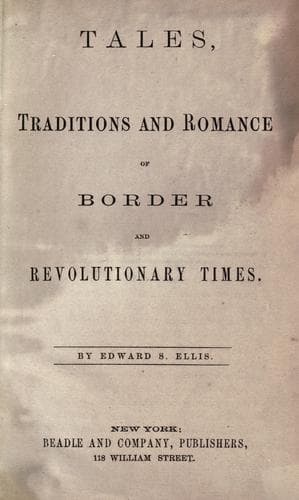
Tales, Traditions and Romance of Border and Revolutionary TimesEllis, Edward Sylvester
History
Tales, Traditions and Romance of Border and Revolutionary Times
Ellis, Edward Sylvester
Frontier and pioneer life -- United States -- Anecdotes; United States -- History -- Revolution, 1775-1783 -- Anecdotes
Cornstalk, a chief excelling even Logan in natural nobility of
character, and great bravery, who conducted the battle and the treaty,
lost his life within a year from that time, under circumstances painful
to all lovers of justice.
Upon the breaking out of the Revolution, the year following, the British
Government, through their agents, made the most strenuous efforts to
induce the Indians to take up the tomahawk in behalf of the king, and
were but too successful. Cornstalk, however, actuated by a high-toned
feeling of repugnance at the idea of breaking his plighted faith, and
foreseeing the inevitable issue of the struggle—being, moreover, a firm
and consistent friend of the Americans—refused to take any part in the
contest, and exerted the utmost of his influence to prevent his tribe
from joining the coalition. His efforts proved futile, however, and the
influence of British presents, and the example of the neighboring
tribes, had the effect which he most dreaded. He did not live to see the
result of the struggle, being killed on the spot where he had but a year
before fought so bravely in defense of his home and the graves of his
sires. After the truce between the tribes and Governor Dunmore had been
agreed upon, a fort was erected at Point Pleasant to commemorate the
battle and keep the Indians in check, and to this fort Cornstalk, after
finding that his efforts to preserve that compact intact would be
unavailing, repaired to explain the position of affairs to its
commanding officer, Captain Arbuckle, and take his advice as to what
course he should pursue. Red-hawk, the Delaware chief, who had also
fought so bravely at Point Pleasant, and who was likewise opposed to
resuming the hatchet, accompanied him in his visit. The chieftain
explained in the fullest manner the state of affairs among the Indians,
and informed Arbuckle that he should be unable to restrain his tribe,
who seemed determined to dig up the hatchet, and once more commence an
exterminating war against the settlers. Under these circumstances,
Arbuckle felt himself justified in detaining the chief and his companion
as hostages, supposing that the fact of their principal leader being in
the hands of the Americans would have the effect of deterring his tribe
from active hostilities. Thinking themselves that such a result might
follow, and earnestly desirous of not taking part in the contest, which
they knew must follow if they returned to their people, they remained
willing captives in the hands of Arbuckle, little dreaming of the fate
which awaited them, and giving all the information which they possessed
regarding the anticipated movements of the various tribes, and of the
British agents among them.
Public-domain text, read in full here on John Shaqi.
Reviews
Reviews
No reviews yet
Be the first to share your thoughts on this work.
Elsewhere in the archive
Join the Discussion
Join the discussion
Sign in to leave a comment or review.
Sign InorCreate an account