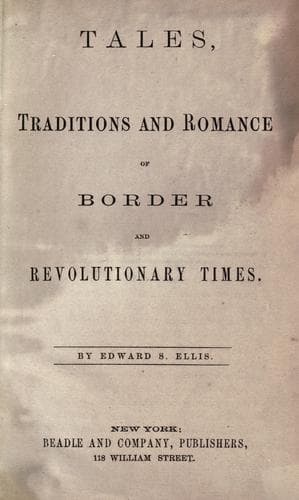
Tales, Traditions and Romance of Border and Revolutionary TimesEllis, Edward Sylvester
History
Tales, Traditions and Romance of Border and Revolutionary Times
Ellis, Edward Sylvester
Frontier and pioneer life -- United States -- Anecdotes; United States -- History -- Revolution, 1775-1783 -- Anecdotes
He was born in New Jersey, but removed with his father to Wythe County,
Virginia, about 1780. In March, 1782, while he and his brother David
were in search of a mare and her foal, which had strayed off into the
woods, they were surprised by the appearance of a small party of
Indians, who darted upon them from behind the trees, and, before
Jonathan had time to make an effort at escape, he found himself in the
grasp of a stalwart warrior, who threatened him with his tomahawk, and
checked the effort, if the idea had risen in his mind. David, however,
started to run, and was pursued by one of the Indians, who soon
returned, leading him by one hand, and with the other holding the handle
of a spear, which he had thrown at him, and which still remained in his
body. On seeing this, another savage stepped up and took hold of the
boy, holding him firmly in his grasp, while the first pulled the spear
out of the wound by main strength. The poor fellow uttered a shriek of
pain at this barbarous surgery, whereupon Jonathan moved toward him and
inquired if he was hurt. He replied that he was, and in a few moments
sank dying to the ground. Jonathan was hurried forward, while one of the
Indians remained with the other boy; but in a few moments made his
appearance with the scalp of David in his hand, and, as he approached,
with an exhibition of the most fiendish delight, he shook the reeking
trophy, from which the blood was still dripping, in the face of the lad,
who was so horror-stricken at the fate of his brother as to be scarcely
able to proceed. Finding it necessary, however, for the salvation of his
own life, he urged himself to his utmost, and they soon overtook the
balance of the party, with whom he found a Mrs. Martin, a neighbor, and
a child, about five years old, whom the Indians had taken captive after
murdering the husband of Mrs. Martin, and all the rest of her family.
They did not long leave her this solace to her misery, but finding the
boy somewhat troublesome, they killed and scalped it, and, to still the
agonizing cries of the broken-hearted mother, one of the inhuman
wretches drew the edge of his knife across her forehead, at the same
time crying "scalp! scalp!" to intimate the fate in store for her if she
did not stop her screams. Finding threats of no avail, they then cut
switches, with which they beat her until she became quiet. One day, as
the boy Alder was sitting on the ground, after eating his dinner, and
being completely worn out with the fatigue of their long and rapid
march, not having risen when ordered to do so, he observed the shadow of
some one standing behind him with a tomahawk in his hand, in the
attitude of striking. He turned suddenly around and beheld a warrior
just in the act of tomahawking him. Finding himself discovered, perhaps,
or struck with the good-natured look which the boy's face wore, he
withheld the blow, and commenced feeling of his head. He afterward told
Public-domain text, read in full here on John Shaqi.
Reviews
Reviews
No reviews yet
Be the first to share your thoughts on this work.
Elsewhere in the archive
Join the Discussion
Join the discussion
Sign in to leave a comment or review.
Sign InorCreate an account