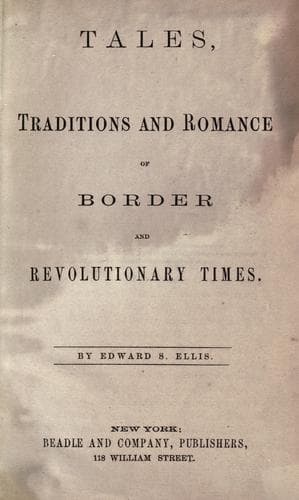
Tales, Traditions and Romance of Border and Revolutionary TimesEllis, Edward Sylvester
History
Tales, Traditions and Romance of Border and Revolutionary Times
Ellis, Edward Sylvester
Frontier and pioneer life -- United States -- Anecdotes; United States -- History -- Revolution, 1775-1783 -- Anecdotes
the boy that the color of his hair had saved his life; for, upon
noticing that it was black and thick, he had thought that he would make
a good Indian, and therefore had concluded to take him to his tribe.
The party by whom Alder had been taken belonged to the Mingo tribe,
whose village was on the north side of Mad River. After many days of
weary travel, and foot-sore and weary, they arrived in its vicinity. The
usual scalp-yell and whoop, announcing the presence of prisoners in the
party, having been given, the whole village turned out to receive them,
and Alder was obliged to undergo the ordeal of running the gauntlet. Two
rows of Indian boys and girls were stationed in front of the
council-house, armed with switches, and, exhausted as he was, he was
compelled to run between them, and make his way within the door of the
council-house for safety from their blows. Fortunately he accomplished
this with his life, and was soon after adopted into an Indian family,
after being purified of his white blood. This was done by washing him in
a decoction of herbs, with soap; and after being dressed in the Indian
fashion, with shirt, leggins, breech-clouts and moccasins, he was
considered as one of the tribe. It is not to be wondered at that it was
long before he could become in any way reconciled to his new way of
life, and that he should mourn for that home which he never again
expected to see. For all one year, the poor boy longed to return to his
mother, brothers and sisters. Every thing was new and strange to him; he
could not speak a word of their language; their food and manner of life
disagreed with him; and, as if to render his misery more complete, he
suffered dreadfully with the fever and ague. His adopted father was
chief of the tribe, and he, as well as his squaw, endeavored to comfort
him in every way possible, and render his situation comfortable; but
they could not quiet his longings for home, and the poor little fellow
spent many lonely, bitter hours, near the foot of a walnut-tree in the
adjacent forest, weeping over his hard lot. The chief had three
daughters, named Mary, Sally and Hannah. Of these, Sally was harshest,
making Jonathan do all the work, and stigmatizing him as a "mean, lousy
prisoner." Mary, the eldest, married a distinguished Shawnee chief,
called Colonel Lewis, and Jonathan went to live with them for a time. Of
this couple he speaks in the warmest eulogy. He says: "The Indians would
generally collect at our camp evenings, to talk over their hunting
expeditions. I would sit up to listen to their stories, and frequently
fell asleep just where I was sitting. After they left, Mary would fix my
bed, and Colonel Lewis would carefully take me up and carry me to it. On
these occasions they would often say, supposing me to be asleep: 'Poor
fellow, we have set up too long for him, and he has fallen asleep on the
cold ground.' And then how softly would they lay me down and cover me
up.
Public-domain text, read in full here on John Shaqi.
Reviews
Reviews
No reviews yet
Be the first to share your thoughts on this work.
Elsewhere in the archive
Join the Discussion
Join the discussion
Sign in to leave a comment or review.
Sign InorCreate an account