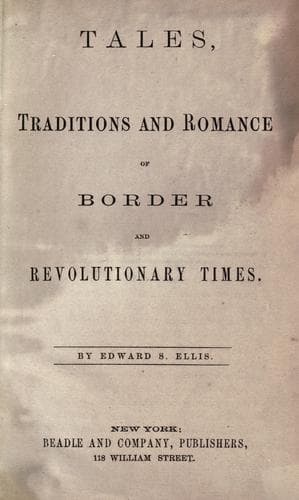
Tales, Traditions and Romance of Border and Revolutionary TimesEllis, Edward Sylvester
History
Tales, Traditions and Romance of Border and Revolutionary Times
Ellis, Edward Sylvester
Frontier and pioneer life -- United States -- Anecdotes; United States -- History -- Revolution, 1775-1783 -- Anecdotes
sorrow of these wild children of the forest, on one side, and, on the
other, the ecstatic joy of the white mother as she folded her long-lost
child in her arms, and the deep emotion of the husband as he strained
his recovered wife to his bosom, combined to form one of the most
moving, novel spectacles ever witnessed in the American wilderness.
One of the captive women had an infant, three months old, at her breast,
born in the Indian's wigwam. A Virginia volunteer instantly recognized
her as his wife, stolen from his log-cabin six months previous, and
rushing forward he snatched her to his bosom, and flew with her to his
tent, where, tearing off the savage costumes of both, he clothed them in
their proper garments. After the first burst of joy was over, he
inquired after his little boy, two years old, who was carried off at the
same time she was made prisoner; but his wife could give no tidings of
him. A few days after, another party of prisoners arrived, in which was
a child whose appearance answered to the description of this little
fugitive. The woman was sent for and the child placed before her. She
looked at it a moment and shook her head. But the next instant the
powerful maternal instinct triumphed, and, recognizing in the little
savage before her her lost darling, she dropped her babe, and snatching
him to her bosom, burst into a torrent of tears. The husband caught the
babe from the ground, and the couple hurried away to his tent. The poor
Indian mother watched their retreating forms, and then burying her head
in her blanket, sobbed aloud. A scene equally affecting occurred between
an aged mother and her daughter, who had been carried off nine years
before, and adopted in a distant tribe. Though the latter had passed
from childhood to womanhood in the forest, differing from other young
squaws only in the tint of her skin, which her wild life could not
wholly bronze, the eyes of the parent detected the features of her child
in the handsome young savage, and calling her by name, she rushed
forward to embrace her. The latter, having forgotten her name and
language, and all her childhood's life, looked on wondering, and turned,
frightened, to her Indian parent. The true mother tried in every way to
recall the memory of her child, and awaken recognition, but in vain. At
length, despairing of success, she gave way to the most passionate
grief. Boquet had been a silent witness of the painful interview. Moved
at the grief of the mother, he approached her, and asked if she could
not recall some song with which she used to sing her child to sleep.
Brightening at the suggestion, she looked up through her tears, and
struck a familiar strain, with which she used to quiet her babe. The
moment the ears of the maiden caught the sound, her countenance changed,
and as the strain proceeded, a strange light stole over her features.
All stood hushed as death, as that simple melody floated out through the
Public-domain text, read in full here on John Shaqi.
Reviews
Reviews
No reviews yet
Be the first to share your thoughts on this work.
Elsewhere in the archive
Join the Discussion
Join the discussion
Sign in to leave a comment or review.
Sign InorCreate an account