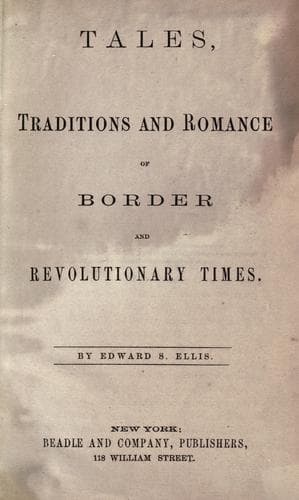
Tales, Traditions and Romance of Border and Revolutionary TimesEllis, Edward Sylvester
History
Tales, Traditions and Romance of Border and Revolutionary Times
Ellis, Edward Sylvester
Frontier and pioneer life -- United States -- Anecdotes; United States -- History -- Revolution, 1775-1783 -- Anecdotes
forest, watching with intense interest the countenances of the two
actors in this touching scene. The eager, anxious look of the mother, as
she sang, and the rapidly changing expression of the captive's face as
she listened, awoke the profoundest sympathy of Boquet's generous heart,
so that he could hardly restrain his feelings. Slowly, almost painfully,
the dormant memory awoke from its long sleep; at length the dark cloud
was rent asunder, and the scenes of childhood came back in all the
freshness of their early springtime, and the half-wild young creature
sank in joy on her mother's bosom.
Some of the children had been so long with their captors that they
regarded them as their true parents, crying bitterly at being separated
from them. Stranger still, the young women had become so attached to
their savage but kind husbands, that, when told they were to be given up
to their white friends, they refused to go; and many of them had to be
bound and brought as prisoners to camp. The promise that they should
take their half-breed children with them, could not change their wishes.
On the other hand, the Indians clung to them with a tenacity and
fondness which made the spectators forget that they were gazing upon
savages. It was pitiful to see their habitual stoicism give way so
completely at the prospect of separation. They made no effort to conceal
their grief; the chieftain's eye, which gleamed like his tomahawk in
battle, now wept like a child's. His strong nature seemed wholly
subdued; his haughty bearing changed to one of humility, as he besought
the white men to treat his pale-face squaw tenderly. His wild life
suddenly lost all its charms, and he hung round the camp to get a sight
of her whom, though she was lost to him, he still loved. He watched near
the log-building in which she was left, leaving it only to bring from
the forests pheasants, wild pigeons, or some delicacy to lay at her
feet. Some of the young captive wives refused to be comforted, and,
using that sagacity they had acquired during their sojourn with the
red-men, managed to escape from their white friends, and, joining their
swarthy lovers, fled with them to the forest.
The American wilderness never before presented such a spectacle as was
exhibited on the banks of the Muskingum. It was no longer a hostile
camp, but a stage on which human nature was displaying its most noble,
attractive traits; or, rather, a sublime poem, enacted in that lovely
natural temple, whose burden was human affection, and whose great
argument, the common brotherhood of mankind.
Boquet and his officers were deeply impressed. They could hardly believe
their own eyes when they saw young warriors whose deeds of daring
ferocity had made their names a terror on the frontier, weeping like
children over their bereavement.
Public-domain text, read in full here on John Shaqi.
Reviews
Reviews
No reviews yet
Be the first to share your thoughts on this work.
Elsewhere in the archive
Join the Discussion
Join the discussion
Sign in to leave a comment or review.
Sign InorCreate an account