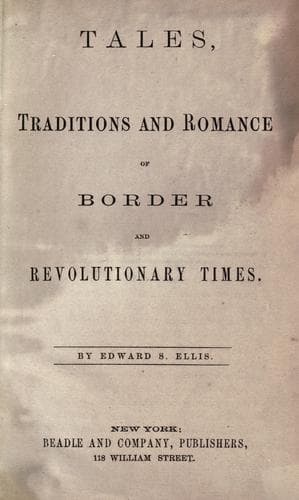
Tales, Traditions and Romance of Border and Revolutionary TimesEllis, Edward Sylvester
History
Tales, Traditions and Romance of Border and Revolutionary Times
Ellis, Edward Sylvester
Frontier and pioneer life -- United States -- Anecdotes; United States -- History -- Revolution, 1775-1783 -- Anecdotes
One of the leading spirits in those stirring days was Mrs. Catherine
Sevier, wife of one of the most distinguished pioneers. Her maiden name
was Sherrill, and her family, as well as that of her future husband,
emigrated from North Carolina and Virginia to what is now East
Tennessee, settling first upon Watauga river. Mr. Sherrill's residence
was finally upon the Nola Chucka. He was a tiller of the soil, a
hard-working man, and "well-to-do in the world;" but he was also skilled
in the use of the rifle, so that it was said, "Sherrill can make as much
out of the ground and out of the woods as any other man. He has a hand
and eye to his work—a hand, an eye, and an ear, for the Indian and the
game."
Buffalo, deer, and wild turkeys came around the cabins of those first
settlers. A providence was in this which some of them recognized with
thankfulness.
Jacob Brown, with his family and friends, arrived from North Carolina
about the same time with the Sherrills, and these two families became
connected by intermarriage with the Seviers, and ever remained faithful
to each other through all the hostile and civil commotions of subsequent
years. The Seviers were among the very earliest emigrants from Virginia,
aiding in the erection of the first fort on the Watauga.
With few exceptions, these emigrants had in view the acquisition of rich
lands for cultivation and inheritance. Some, indeed, were there, or
came, who were absconding debtors, or refugees from justice, and from
this class were the Tories of North Carolina mostly enlisted.
The spirit of the hunter and pioneer cannot well content itself in a
permanent location, especially when the crack of a neighbor's rifle, or
the blast of his hunting-horn can be heard by his quick ear; therefore
did these advanced guards frequently change their homes when others
_crowded_ them, at _miles distance_. It must be remembered that their
advance into the wilderness could only be made by degrees, step by step,
through years of tedious waiting and toilsome preparation. And thus,
though they had a lease of the land for eight years from the Cherokees,
a foothold in the soil, stations of defense, and evidently had taken a
bond of fate, assuring them in the prospect of rich inheritances for
their children, they could not all abide while the great West and
greater Future invited onward. Richer lands, larger herds of buffaloes,
more deer, and withal so many Indians were in the distance, upon the
Cumberland and Kentucky rivers. The emigrants advanced, and they took no
steps backward. In a few years they were found organizing "provisional
governments" in Kentucky, and at the Bluffs, the site of the beautiful
capital of Tennessee. These Watauga and Nola Chucka pioneers were
leading spirits throughout.
Public-domain text, read in full here on John Shaqi.
Reviews
Reviews
No reviews yet
Be the first to share your thoughts on this work.
Elsewhere in the archive
Join the Discussion
Join the discussion
Sign in to leave a comment or review.
Sign InorCreate an account