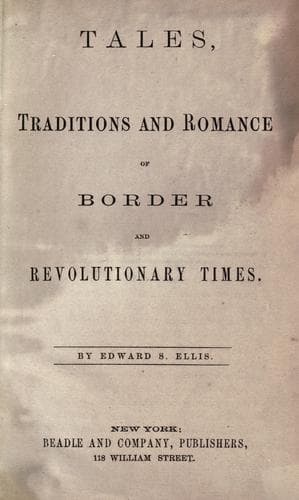
Tales, Traditions and Romance of Border and Revolutionary TimesEllis, Edward Sylvester
History
Tales, Traditions and Romance of Border and Revolutionary Times
Ellis, Edward Sylvester
Frontier and pioneer life -- United States -- Anecdotes; United States -- History -- Revolution, 1775-1783 -- Anecdotes
In the first Cherokee war of 1776, the early settlements were in great
danger of being destroyed. The prowling savages plucked off the settlers
in detail, and, though somewhat successful in these aims, they resolved
to attack the settlements and stations at different points on the same
day—in June, 1776. But they were so defeated in the battles of Long
Island, and at the Island Flats, on the Holston, and in their attack and
siege of the Watauga Fort, that a happy chance was wrought, and hopes of
quiet were encouraged.
The attack on the latter station was conducted by an experienced Indian
chief, Old Abraham, of the Chilowee Mountain region. This was a fierce
attack, but the fort fortunately held within it two of the most resolute
men who ever touched the soil of Tennessee—James Robertson and John
Sevier—they having then no higher title than Captains. Some thirty men
were under their command or direction.
The approach of the Indians was stealthy, and the first alarm was given
by the flight and screams of some females, who were closely pursued by
the Indians in large force. One of the women was killed, and one or two
captured. In this party of females was Miss Catherine Sherrill, daughter
of Samuel Sherrill, who had moved into the fort only on the previous
day.
Miss Sherrill was already somewhat distinguished for nerve, fleetness of
foot, and decision of character. Although at other times she proved
herself to "know no fear," and could remain unmoved when danger
threatened, yet on this occasion she admits that she did run, and "run
her best." She was very tall and erect, her whole appearance such as to
attract the especial notice of the savages, who pursued her with
eagerness; and, as they intercepted the direct path to the gate of the
fort, she made a circuit to reach its inclosures on another side,
resolved, as she said, to "scale the palisades." In this effort, some
one within the defenses attempted to aid, but his foot slipped, or the
object on which he was standing gave way, and both fell to the ground on
opposite sides of the wall. The Indians were coming with all speed,
firing and shooting arrows repeatedly. "Indeed," she said, "the bullets
and arrows came like hail. It was now leap the palisades or die, for I
would not live a captive." She recovered from the fall, and in a moment
was over and within the defenses, and "by the side of one _in uniform_."
This was none other than Captain John Sevier, and this the first time
she ever saw him—the beginning of an acquaintance destined in a few
years to ripen into a happy union which endured for nearly forty years.
"The manner in which she ran and jumped on that occasion was often the
subject of remark, commendation and laughter."
Public-domain text, read in full here on John Shaqi.
Reviews
Reviews
No reviews yet
Be the first to share your thoughts on this work.
Elsewhere in the archive
Join the Discussion
Join the discussion
Sign in to leave a comment or review.
Sign InorCreate an account