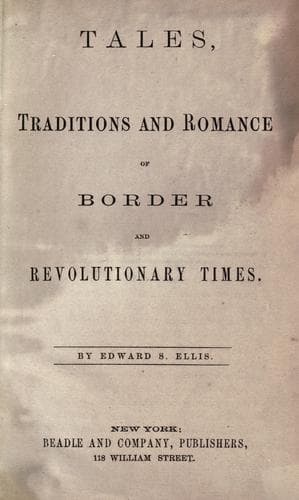
Tales, Traditions and Romance of Border and Revolutionary TimesEllis, Edward Sylvester
History
Tales, Traditions and Romance of Border and Revolutionary Times
Ellis, Edward Sylvester
Frontier and pioneer life -- United States -- Anecdotes; United States -- History -- Revolution, 1775-1783 -- Anecdotes
of their enterprise, and thirsting for blood, were for massacring them
at once. During the controversy, the prisoners, bound hand and foot,
were thrust into a pen of logs, where they were kept under guard of the
Tories and their leader, an infamous wretch by the name of Becraft. The
pen was near enough to the council to hear what was going on, and Harper
understood enough of the Indian language to catch the import of their
"talk." Becraft took pains, too, to inform them of the wishes of the
majority of the Indians, and in abusive language told them that they
would "all be in hell before morning." The influence of Brandt—at all
times powerful—enabled him to prevent bloodshed, and the others were
induced to forego their bloodthirsty desires, for the present, at least.
In the morning, Harper was again brought before the chief and
interrogated. With great presence of mind he reasserted his story, and,
although the other eyed him with the most searching gaze, he betrayed no
evidence of indecision; and at length the chief, convinced, apparently,
of the truth, gave the order to commence their march for Niagara. The
prisoners were not allowed to reach their destination, without passing
through fearful ordeals. One day they stopped at a mill kept by a Tory,
who, with both of his daughters, counseled Brandt to destroy "the
infernal Whigs." This coinciding with the desires of the Tories and a
majority of the Indians, the chief found it difficult to restrain them,
and prevent the sacrifice. On another occasion they met a loyalist, who
was well acquainted with Brandt and Harper, who told the former that he
had been deceived—that there were no troops at Schoharie. This led to
another searching inquiry, but Harper persisted in his story with so
much apparent candor as again to elude detection. But when the party
reached the Chemung River, they had to pass a still more fearful trial.
On reaching this point, Brandt and his warriors raised a whoop, as is
customary with the Indians when they have prisoners—it was answered by a
single _death yell_! In a few moments a single Indian made his
appearance, who proved to be the young chief Cheyendowah. His story was
soon told. Of the eleven who started for the Minisink settlement, he
alone was left so tell the tale of their massacre at the hands of their
prisoners. The others had gathered about him, excited listeners to the
melancholy narrative, and the effect of the recital upon these already
implacable warriors was fearful in the extreme. "Revenge!" seemed to
leap from every tongue, and their faces were wrought into an expression
of the fiercest determination to immolate the unhappy prisoners on the
spot. Every hand sought a weapon simultaneously, and the glittering
tomahawk and keener scalping-knife leaped into the air, while their eyes
glared ferociously upon Harper and his companions, who, conscious that
their fate was inevitable, awaited it with what composure they could
command.
Public-domain text, read in full here on John Shaqi.
Reviews
Reviews
No reviews yet
Be the first to share your thoughts on this work.
Elsewhere in the archive
Join the Discussion
Join the discussion
Sign in to leave a comment or review.
Sign InorCreate an account