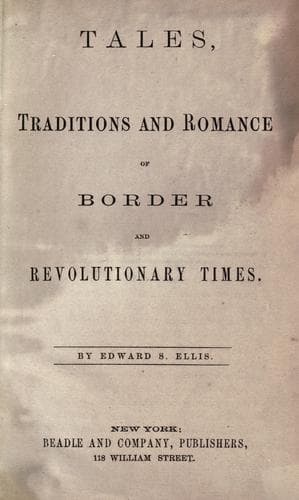
Tales, Traditions and Romance of Border and Revolutionary TimesEllis, Edward Sylvester
History
Tales, Traditions and Romance of Border and Revolutionary Times
Ellis, Edward Sylvester
Frontier and pioneer life -- United States -- Anecdotes; United States -- History -- Revolution, 1775-1783 -- Anecdotes
With one accord, the savages rushed in a tumultuous throng,
with uplifted weapons, upon their victims. Brandt had no power to
control the storm, and did not attempt it. As well might he attempt to
stay the whirlwind in its fury, or beat back the mountain torrent in its
course; the doom of the white men was apparently sealed, It was to the
magnanimity of one from whom they could least anticipate such
forbearance, that they were indebted for their lives. Rushing between
the infuriated warriors and their anticipated prey, the young chief
Cheyendowah waved back the crowd with an imperious gesture which
commanded attention. When silence was restored, he surprised his
auditors by an urgent appeal in behalf of the prisoners. "It was not
they," he said, "who had killed their brethren, and to take the lives of
innocent men would not punish the guilty. The Great Spirit would be
angry with them if they should do this wicked thing." Pointing upward,
in words of majestic eloquence, he told them that "Manitou was looking
upon them, and would send his thunders to destroy their families, their
homes, and themselves, if they sacrificed the white men in their
vengeance." He told them it was cowardly to kill men who could not
defend themselves, and none but squaws would take such an advantage.
Appealing thus alternately to their fears, their humanity, and their
superstition, he wrought upon their better nature, and was successful in
inducing them to forego their anticipated vengeance. One by one their
weapons were returned to their accustomed places, and with subdued and
less excited feelings, they recommenced their onward march to Niagara,
which they reached at length; not, however, without the severest
suffering by the way.
The eloquence of the red-man is proverbial. Many a time has the captive
trembled when it has been exercised against him; and thrilled with joy,
when it was exerted in his behalf. In the swift future, when all traces
of his existence, who was once the master of this mighty continent, is
swept away, and our children's children read of him, as an ancient and
perished myth, the records of his eloquence shall be left alive. One of
the best specimens of Indian rhetoric, is the speech of Tecumseh, at the
grand council of the Creeks. One, who was present, and heard it as it
fell from his lips, General Dale, says:
Public-domain text, read in full here on John Shaqi.
Reviews
Reviews
No reviews yet
Be the first to share your thoughts on this work.
Elsewhere in the archive
Join the Discussion
Join the discussion
Sign in to leave a comment or review.
Sign InorCreate an account