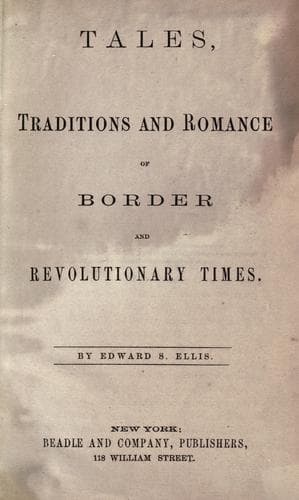
Tales, Traditions and Romance of Border and Revolutionary TimesEllis, Edward Sylvester
History
Tales, Traditions and Romance of Border and Revolutionary Times
Ellis, Edward Sylvester
Frontier and pioneer life -- United States -- Anecdotes; United States -- History -- Revolution, 1775-1783 -- Anecdotes
The execution of Colonel Isaac Hayne, which took place later in the
history of the Carolinas, presents a still more touching picture of the
devotion of a child and the tyranny of a British minion. After
Charleston had fallen into the hands of the British, many of the Whigs
of South Carolina were induced to take the protections which were
offered by Lord Cornwallis. They were led to this step by the belief
that in the South the cause was hopeless, and were promised, by virtue
of these protections, to be allowed to remain quietly in their homes and
take no part in the contest. Their surprise was great, when, soon after,
they were called upon to take up arms under the British commanders and
against their countrymen. Conceiving that faith had been broken with
them, and their promises of neutrality no longer binding, they tore up
their protections, and at once ranked themselves under the Continental
leaders. Among those was Colonel Hayne, a man of unblemished reputation,
fine talents and lofty patriotism. Indignant at the course pursued by
the British, he hastened to the American army, and began to take active
part in the contest. Unfortunately, he fell into the enemy's hands, was
conveyed to Charleston, submitted, by order of Rawdon, to a mock trial,
and, to the horror of all, was condemned to death. He received his
sentence with calmness, but the whole country was horrified. Both
English and Americans interceded for his life, and the ladies of
Charleston immortalized themselves by the spirited address which they
framed and delivered to his captors in his behalf. All was of no avail.
The cruel heart of Rawdon could not be moved; not even the captive's
motherless children, with bended knees and tearful prayers, could move
his obdurate nature.
Hayne's eldest child was a boy of thirteen, who was permitted to remain
in prison with him up to the time of his execution. This boy was
actuated by an affection for his father of the most romantic earnestness
and fervor. Beholding him loaded with irons and condemned to die, he was
overwhelmed with consternation and sorrow; nothing could alleviate his
distress. In vain did his parent endeavor to console him by reminding
him that this unavailing grief only heightened his own misery—that he
was only to leave this world to be admitted into a better—that it was
glorious to die for liberty. The boy would not be comforted.
"To-morrow," said the unhappy father, "I set out for immortality. You
will accompany me to the place of my execution, and when I am dead, take
my body and bury it beside your poor mother."
In an agony of grief the child fell weeping on his father's neck,
crying:
"Oh, my father, my father, I die with you!"
The chains which bound the prisoner prevented his returning the embrace,
but he said, in reply:
"Live, my son—live to honor God by a good life—live to take care of your
brothers and sisters."
Public-domain text, read in full here on John Shaqi.
Reviews
Reviews
No reviews yet
Be the first to share your thoughts on this work.
Elsewhere in the archive
Join the Discussion
Join the discussion
Sign in to leave a comment or review.
Sign InorCreate an account