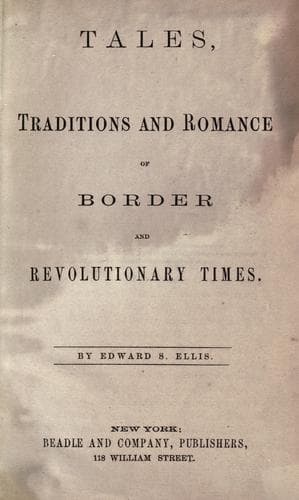
Tales, Traditions and Romance of Border and Revolutionary TimesEllis, Edward Sylvester
History
Tales, Traditions and Romance of Border and Revolutionary Times
Ellis, Edward Sylvester
Frontier and pioneer life -- United States -- Anecdotes; United States -- History -- Revolution, 1775-1783 -- Anecdotes
The next morning the son walked beside his father to the place of
execution. The history of the war scarcely affords a more heart-rending
incident. There was not a citizen of Charleston whose bosom did not
swell with anguish and indignation. There was sorrow in every
countenance, and when men spoke with each other, it was in accents of
horror.
[Illustration:
The Implacable Governor.—_Page_ 14.
]
When the two came within sight of the gallows, the parent strengthened
himself, and said to the weeping boy:
"Tom, my son, show yourself a man! That tree is the boundary of my life
and all my life's sorrow. Beyond that the wicked cease from troubling,
and the weary are at rest. Don't lay too much at heart our separation—it
will be short. 'Twas but lately your mother died; to-day I die; and you,
though young, must shortly follow."
"Yes, my father," replied the broken-hearted boy, "I shall soon follow
you; for, indeed, I feel that I can not live long."
And this melancholy anticipation was fulfilled in a manner far more
dreadful than is implied in the mere extinction of life. When his father
was tom from his side, his tears flowed incessantly, and his bosom was
convulsed with sobs; but when he saw that beloved parent in the hands of
the executioner, the halter adjusted to his neck, and then his form
convulsively struggling in the air, the fountain of his tears was
suddenly stanched, and he stood transfixed with horror. He never wept
again. When all was over he was led from the scene, but there was a
wildness in his look, a pallor in his cheek, which alarmed his friends.
The terrible truth was soon made known. His reason had fled forever. It
was not long before he followed his parents to the grave, but his death
was even sadder than his father's. In his last moments he often called
the beloved name in accents of such anguish that the sternest hearted
wept to hear him. But the merciful all-Father took him home and restored
him forever to the side of that parent, the shock of whose rude death
sundered the tender strings of a child's heart.
Lord Rawdon should have been proud of this noble feat. He was one of
those who
"Stand, to move the world, on a child's heart."
The outrageous oppression of Governor Tryon and Lord Rawdon were only a
few among many instances of the spirit shown by Government officials,
until the people of the Colonies were driven to that universal rebellion
which resulted in the establishment of our independence. And when that
struggle was begun, British arrogance and cruelty asserted itself, in
her officers and minions, in those equivocal shapes which ought to make
British history blush with shame along the ensanguined record. It has
been truly said that a wrong begun is only maintained by a wrong
continued.
Public-domain text, read in full here on John Shaqi.
Reviews
Reviews
No reviews yet
Be the first to share your thoughts on this work.
Elsewhere in the archive
Join the Discussion
Join the discussion
Sign in to leave a comment or review.
Sign InorCreate an account