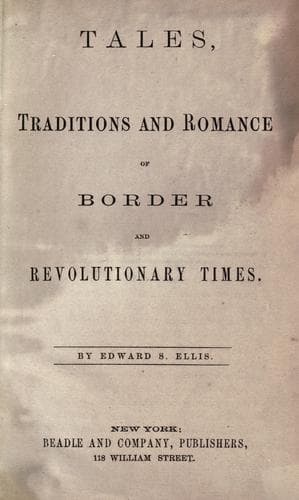
Tales, Traditions and Romance of Border and Revolutionary TimesEllis, Edward Sylvester
History
Tales, Traditions and Romance of Border and Revolutionary Times
Ellis, Edward Sylvester
Frontier and pioneer life -- United States -- Anecdotes; United States -- History -- Revolution, 1775-1783 -- Anecdotes
A more humble family, but one which did good service in the cause of
liberty, was that of William Maybin. Maybin was taken prisoner, it was
supposed, at Sumter's surprise, on Fishing Creek, August, 1780. He was
carried to Charleston, and died in one of those charnel-houses of
freedom, a prison-ship. Here, just as he was dying, he was discovered by
his wife's brother, Benjamin Duncan, a soldier in the British army, who
obtained permission to bring his corpse on shore for burial. Duncan then
visited his bereaved sister, and, after a short stay, returned to his
duty, promising, as soon as possible, to come back and provide for her
and his other sister, a married woman. As a pledge, he left with her his
watch, and some other articles. The news of this valuable deposit was
soon spread among the loyalists; it was rumored that the watch was of
gold, falsely, for it was a silver one. Spoil was ever first in the
thoughts of many of those guilty traitors; and two marauders soon came
to the house of the widow and orphans. They demanded the watch,
threatening to take the lives of the helpless women and children, if it
was not delivered. Mrs. Maybin, anxious only, like a true mother, for
the safety of her children, fled to the woods, leaving her sister to
contend alone with the ruffians. She succeeded in baffling their
cupidity. They did not find the watch, although it was hidden under the
head of the bed. It became the property of Maybin's son, who valued it
as a memento of the courage of his aunt.
This family had their full share of trial and privation. When Rawdon's
army pursued General Greene on his retreat from Ninety-six, they
encamped about a week at Colonel Glenn's Mills, on the Enoree. They then
marched through the Fork, and crossed at Lisle's Ford. On this march,
the soldiers plundered everything on their way. The only piece of meat
she had left for her family, and which she had hidden on the wood-beams
of the house, was found and taken away. A small gray mare, called
"Dice," her only beast, was also stolen, but was afterward recovered.
This disgraceful foray, had, it is said, the sanction of Lord Rawdon.
On another occasion, a Tory visited Mrs. Maybin's cabin, and finding a
piece of homespun in her loom, cut it out and bore it away as a prize.
The wretch who could look upon the almost naked children of a poor
widow, and take from her the means of a scanty covering, did not,
however, escape. Little Ephraim Lyle, afterward met him, and, finding
the cloth upon his legs in a pair of leggins, inflicted upon him a
severe drubbing, and forced him to relinquish the spoil.
Horrible, truly, were these sufferings and privations, but far more real
than the trials of fortitude to which some "leading citizens" were
subjected.
Public-domain text, read in full here on John Shaqi.
Reviews
Reviews
No reviews yet
Be the first to share your thoughts on this work.
Elsewhere in the archive
Join the Discussion
Join the discussion
Sign in to leave a comment or review.
Sign InorCreate an account