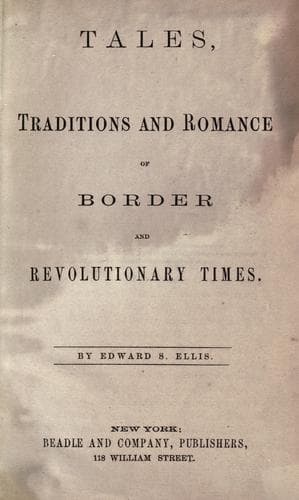
Tales, Traditions and Romance of Border and Revolutionary TimesEllis, Edward Sylvester
History
Tales, Traditions and Romance of Border and Revolutionary Times
Ellis, Edward Sylvester
Frontier and pioneer life -- United States -- Anecdotes; United States -- History -- Revolution, 1775-1783 -- Anecdotes
John Clark, settled on the Enoree, near the place now called Clarke's
Ford. He was a staunch and zealous Whig during the war. In a skirmish at
the ford, under the command of Captain Jones, he was shot through the
leg, and with difficulty escaped to a bluff a mile distant. To this
place the enemy traced him, by his blood, and took him prisoner. His
mother furnished him with a bit of salve, and a piece of cloth to draw
and bind up his wound. His captors compelled him to mount a very poor
horse, and ride him, with nothing to separate him from the animal's
sharp backbone but an old bed-quilt, which his mother had given him from
her own scanty covering. With his feet bound under the _garron_, he was
compelled to ride, in great and increasing agony, more than forty miles,
to Ninety-six. There he was cast into prison, in his wounded condition,
in the midst of poor fellows suffering under a virulent type of
small-pox. He was the tenth sufferer, and marvelously recovered, was
liberated, made his way home, and lived long after the close of the
revolutionary struggle. His descendants are still to be found in
Newberry district.
[Illustration:
Brady's Leap.—_Page_ 43.
]
BRADY'S LEAP.
Captain Samuel Brady was the Daniel Boone of Ohio, and was as efficient
in the settlement of that State as his illustrious cotemporary was in
establishing the domain of the white man in the State of Kentucky. He
entered the army at the commencement of our Revolutionary struggle, and
was engaged at the siege of Boston, as well as in many other important
contests, during the war for independence. He was a Lieutenant under
Wayne at the massacre of Paoli, when that officer was surprised, and the
greater portion of his command cut to pieces and destroyed in cold
blood. Toward the close of the war, he was Captain of a corps of rangers
at Fort Pitt, under General Brodhead, and rendered effectual service
against the Indians, who were in league with the British. He had lost a
father and brother at the hands of the red-skins, and swore to take a
terrible revenge.
To a mind fertile in expedient, and quick as a flash of light in its
deliberations, he added a frame well-knit, though slight, and a
constitution of iron mold. He was an Indian-fighter _con amore_, and the
greater portion of his time was spent in the war-path. Many are the
deeds of daring and thrilling adventure related of him. A volume might
be written embracing the adventures and hair-breadth escapes of the
gallant Captain; but, in common with an immense mass of unwritten
tradition equally valuable and interesting, they are fast being
forgotten and buried in the graves of the past generation.
Public-domain text, read in full here on John Shaqi.
Reviews
Reviews
No reviews yet
Be the first to share your thoughts on this work.
Elsewhere in the archive
Join the Discussion
Join the discussion
Sign in to leave a comment or review.
Sign InorCreate an account