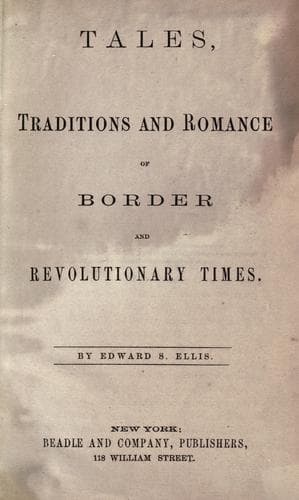
Tales, Traditions and Romance of Border and Revolutionary TimesEllis, Edward Sylvester
History
Tales, Traditions and Romance of Border and Revolutionary Times
Ellis, Edward Sylvester
Frontier and pioneer life -- United States -- Anecdotes; United States -- History -- Revolution, 1775-1783 -- Anecdotes
It was in May, 1780, that he commenced his march. The season was
uncommonly wet. Every considerable stream was swollen; neither road,
bridge nor house facilitated their march, or shielded their repose. Part
of their provision was picked up by the way, as they crept, rather than
marched through the wilderness by night, and lay concealed in its
branches by day. The slightest trace of his movement, the print of a
white man's foot on the sand of a river, might have occasioned the
extermination of the party. Brady was versed in all the wiles of Indian
"strategy," and, dressed in the full war dress of an Indian warrior, and
well acquainted with their languages, he led his band in safety near to
the Sandusky towns, without seeing a hostile Indian.
The night before he reached Sandusky he saw a fire, approached it, and
found two squaws reposing beside it. He passed on without molesting
them. But his Chickasaws now deserted. This was alarming, for it was
probable they had gone over to the enemy. However, he determined to
proceed. With a full knowledge of the horrible death that awaited him if
taken prisoner, he passed on, until he stood beside the town, and on the
bank of the river.
His first care was to provide a place of concealment for his men. When
this was effected, having selected one man as the companion of his
future adventures, he waded the river to an island partially covered
with driftwood, opposite the town, where he concealed himself and
comrade for the night.
In constancy of purpose, in cool, deliberate courage, the Captain of the
Rangers will compare with any hero of this age, or any other. Neither
banner nor pennon waved over him. He was hundreds of miles in the heart
of an enemy's country—an enemy who, had they possessed it, would have
given his weight in gold for the pleasure of burning him to death with a
slow fire—adding to his torments, both mental and physical, every
ingredient that savage ingenuity could supply.
Who that has poetry of feeling, or feeling of poetry, but must pause
over such a scene, and, in imagination, contemplate its features! The
murmuring river; the sylvan landscape; as each was gazed upon by that
lonely, but dauntless warrior, in the still midnight hour.
The next morning a dense fog spread over hill and dale, town and river.
All was hid from Brady's eyes, save the logs and brush around him. About
eleven o'clock it cleared off, and afforded him a view of about three
thousand Indians, engaged in the amusements of the race ground.
They had just returned from Virginia or Kentucky with some very fine
horses. One gray horse in particular attracted his notice. He won every
race until near evening, when, as if envious of his speed, two riders
were placed on him, and thus he was beaten. The starting post was only a
few rods above where Brady lay, and he had a pretty fair chance of
enjoying the amusement, without the risk of losing any thing by betting
on the race.
Public-domain text, read in full here on John Shaqi.
Reviews
Reviews
No reviews yet
Be the first to share your thoughts on this work.
Elsewhere in the archive
Join the Discussion
Join the discussion
Sign in to leave a comment or review.
Sign InorCreate an account