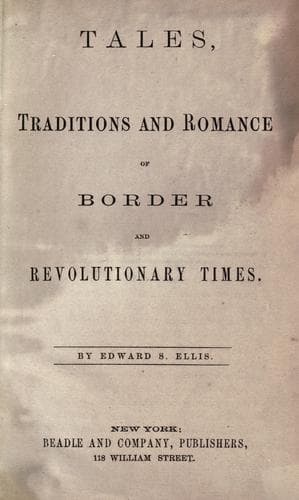
Tales, Traditions and Romance of Border and Revolutionary TimesEllis, Edward Sylvester
History
Tales, Traditions and Romance of Border and Revolutionary Times
Ellis, Edward Sylvester
Frontier and pioneer life -- United States -- Anecdotes; United States -- History -- Revolution, 1775-1783 -- Anecdotes
He made such observation through the day as was in his power, waded out
from the island at night, collected his men, went to the Indian camp he
had seen as he came out; the squaws were still there; he took them
prisoners, and continued his march homeward.
The map furnished by General Broadhead was found to be defective. The
distance was represented to be much less than it really was. The
provisions and ammunition of the men were exhausted by the time they got
to the Big Beaver, on their return. Brady shot an otter, but could not
eat it. The last load was in his rifle. They arrived at an old
encampment, and found plenty of strawberries, which they stopped to
appease their hunger with. Having discovered a deer track, Brady
followed it, telling the men he would perhaps get a shot at it. He had
gone but a few rods when he saw the deer standing broadside to him. He
raised his rifle and attempted to fire, but it flashed in the pan, and
he had not a priming of powder. He sat down, picked the touch-hole, and
then started on. After going a short distance the path made a bend, and
he saw before him a large Indian on horseback, with a white child
before, and its captive mother behind him on the horse, and a number of
warriors marching in the rear. His first impulse was to shoot the Indian
on horseback, but, as he raised his rifle, he observed the child's head
to roll with the motion of the horse. It was fast asleep, and tied to
the Indian. He stepped behind the root of a tree, and waited until he
could shoot the Indian, without danger to the child or its mother.
When he considered the chance certain, he shot the Indian, who fell from
his horse, and the child and its mother fell with him. Brady called to
his men with a voice that made the forest ring, to surround the Indians
and give them a general fire. He sprung to the fallen Indian's
powder-horn, but could not pull it off. Being dressed like an Indian,
the woman thought he was one, and said:
"Why did you shoot your brother?"
He caught up the child, saying:
"Jenny Stupes, I am Captain Brady; follow me, and I will secure you and
your child."
He caught her hand in his, carrying the child under the other arm, and
dashed into the brush. Many guns were fired at him by this time, but no
ball harmed him, and the Indians, dreading an ambuscade, were glad to
make off. The next day he arrived at Fort McIntosh with the woman and
her child. His men had got there before him. They had heard his
war-whoop, and knew it was Indians he had encountered, but, having no
ammunition, they had taken to their heels, and ran off. The squaws he
had taken at Sandusky, availing themselves of the panic, had also made
their escape.
Public-domain text, read in full here on John Shaqi.
Reviews
Reviews
No reviews yet
Be the first to share your thoughts on this work.
Elsewhere in the archive
Join the Discussion
Join the discussion
Sign in to leave a comment or review.
Sign InorCreate an account