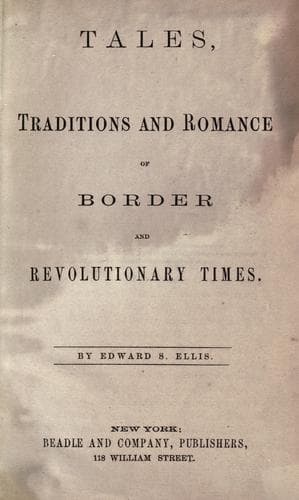
Tales, Traditions and Romance of Border and Revolutionary TimesEllis, Edward Sylvester
History
Tales, Traditions and Romance of Border and Revolutionary Times
Ellis, Edward Sylvester
Frontier and pioneer life -- United States -- Anecdotes; United States -- History -- Revolution, 1775-1783 -- Anecdotes
The country on both sides of Mahoning, at its mouth, is rough and
mountainous, and the stream, which was then high, very rapid. Several
ineffectual attempts were made to wade it, which they at length
succeeded in doing, three or four miles above the canoes. Next, a fire
was made, their clothing dried, and arms inspected; and the party moved
toward the Indian camp, which was pitched on the second bank of the
river. Brady placed his men at some distance on the lower or first bank.
The Indians had brought from Sewickly a stallion, which they had
fettered and turned to pasture on the lower bank. An Indian, probably
the owner, under the _law of arms_, came frequently down to him, and
occasioned the party no little trouble. The horse, too, seemed willing
to keep their company, and it required considerable circumspection to
avoid all intercourse with either. Brady became so provoked that he had
a strong inclination to tomahawk the Indian, but his calmer judgment
repudiated the act, so likely to put to hazard a more decisive and
important achievement.
At length the Indians seemed quiet, and the Captain determined to pay
them a closer visit, which he succeeded in doing, then returned, posted
his men, and in the deepest silence all awaited the break of day. When
it appeared, the Indians arose and stood around their fires, exulting
doubtless in the scalps they had taken, the plunder they had acquired,
and the injuries they had inflicted on their enemies. Precarious joy!
short-lived triumph! the avenger of blood was beside them. At a signal
given, seven rifles cracked, and five Indians were dead ere they fell.
Brady's well-known war-cry was heard, his party were among them, and
their rifles (mostly empty) were all secured. The remaining Indians
instantly fled and disappeared. One was pursued by the trace of his
blood, which he seems to have succeeded in staunching. The pet Indian
then imitated the cry of a young wolf, which was answered by the wounded
man, and the pursuit was again renewed. A second time the wolf cry was
given and answered, and the pursuit continued into a windfall. Here he
must have espied his pursuers, for he answered no more. Brady found his
remains three weeks afterwards, being led to the place by ravens that
were preying on the carcass.
The horse was unfettered, the plunder gathered, and the party commenced
their return to Pittsburg, most of them descending in the Indian canoes.
Three days after their return, the first detachment came in. They
reported that they had followed the Indians closely, but that the latter
had got into their canoes and made their escape.
Public-domain text, read in full here on John Shaqi.
Reviews
Reviews
No reviews yet
Be the first to share your thoughts on this work.
Elsewhere in the archive
Join the Discussion
Join the discussion
Sign in to leave a comment or review.
Sign InorCreate an account