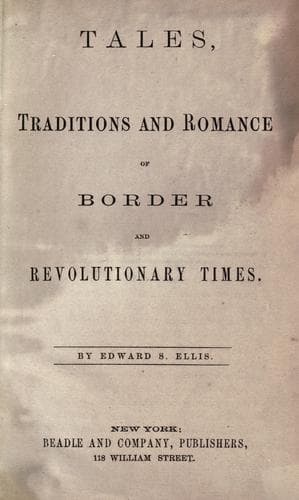
Tales, Traditions and Romance of Border and Revolutionary TimesEllis, Edward Sylvester
History
Tales, Traditions and Romance of Border and Revolutionary Times
Ellis, Edward Sylvester
Frontier and pioneer life -- United States -- Anecdotes; United States -- History -- Revolution, 1775-1783 -- Anecdotes
"I will stop," said Brady, "and shoot the dog, and then we can get along
better."
He selected the root of a tall chestnut tree which had fallen westward,
for his place of ambush. He walked from the west end of the tree or log
to the east, and sat down in the pit made by the raising of the root. He
had not been long there when a small slut mounted the log at the west
end, and, with her nose to the trunk, approached him. Close behind her
followed a plumed warrior. Brady had his choice. He preferred shooting
the slut, which he did; she rolled off the log, stone dead, and the
warrior, with a loud whoop, sprung into the woods and disappeared. He
was followed no further.
Many of Captain Brady's adventures occurred at periods of which no
certainty as to dates can now be had. The following is of that class:
His success as a partisan had acquired for him its usual
results—approbation with some, and envy with others. Some of his brother
officers censured the Commandant for affording him such frequent
opportunities for honorable distinction. At length an open complaint was
made, accompanied by a request, in the nature of a demand, that others
should be permitted to share with Brady the perils and honors of the
service, abroad from the fort. The General apprised Brady of what had
passed, who readily acquiesced in the proposed arrangement; and an
opportunity was not long wanting for testing its efficiency.
The Indians made an inroad into the Sewickly settlement, committing the
most barbarous murders of men, women, and children; stealing such
property as was portable, and destroying all else. The alarm was brought
to Pittsburg, and a party of soldiers under the command of the emulous
officers dispatched for the protection of the settlement, and
chastisement of the foe. From this expedition Brady was, of course,
excluded; but the restraint was irksome to his feelings.
The day after the detachment had marched, he solicited permission from
the commander to take a small party for the purpose of "catching the
Indians," but was refused. By dint of importunity, however, he at length
wrung from him a reluctant consent, and the command of five men; to this
he added his _pet_ Indian, and made hasty preparation.
Instead of moving toward Sewickly, as the first detachment had done, he
crossed the Alleghany at Pittsburg, and proceeded up the river.
Conjecturing that the Indians had descended the stream in canoes, till
near the settlement; he was careful to examine the mouths of all creeks
coming into it, particularly from the Southeast. At the mouth of Big
Mahoning, about six miles above Kittanning, the canoes were seen drawn
up to its western bank. He instantly retreated down the river, and
waited for night. As soon as it was dark, he made a raft, and crossed to
the Kittanning side. He then proceeded up the creek, and found that the
Indians had, in the meantime, crossed the creek, as their canoes were
drawn to its upper or north-eastern bank.
Public-domain text, read in full here on John Shaqi.
Reviews
Reviews
No reviews yet
Be the first to share your thoughts on this work.
Elsewhere in the archive
Join the Discussion
Join the discussion
Sign in to leave a comment or review.
Sign InorCreate an account