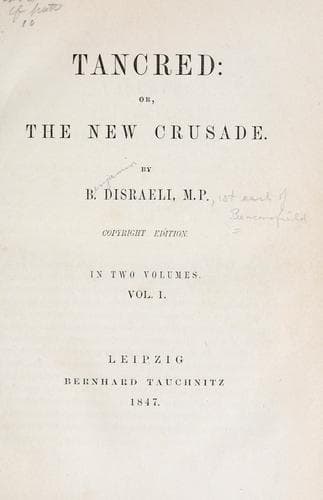
Tancred; Or, The New CrusadeDisraeli, Benjamin, Earl of Beaconsfield
ReligionJewish
Tancred; Or, The New Crusade
Disraeli, Benjamin, Earl of Beaconsfield
Christianity and other religions -- Judaism -- Fiction; Judaism -- Relations -- Christianity -- Fiction
A variety of causes and circumstances had impressed him with a
conviction that what is called fashionable life was a compound of
frivolity and fraud, of folly and vice; and he resolved never to enter
it. To this he was, perhaps, in some degree unconsciously prompted by
his reserved disposition, and by his painful sense of inexperience, for
he looked forward to this world with almost as much of apprehension
as of dislike. To politics, in the vulgar sense of the word, he had an
equal repugnance. He had a lofty idea of his duty to his sovereign and
his country, and felt within him the energies that would respond to a
conjuncture. But he acceded to his title in a period of calmness, when
nothing was called in question, and no danger was apprehended; and as
for the fights of factions, the duke altogether held himself aloof from
them; he wanted nothing, not even the blue ribbon which he was soon
obliged to take. Next to his domestic hearth, all his being was
concentrated in his duties as a great proprietor of the soil. On
these he had long pondered, and these he attempted to fulfil. That
performance, indeed, was as much a source of delight to him as of
obligation. He loved the country and a country life. His reserve seemed
to melt away the moment he was on his own soil. Courteous he ever
was, but then he became gracious and hearty. He liked to assemble ‘the
county’ around him; to keep ‘the county’ together; ‘the county’ seemed
always his first thought; he was proud of ‘the county,’ where he reigned
supreme, not more from his vast possessions than from the influence of
his sweet yet stately character, which made those devoted to him who
otherwise were independent of his sway.
From straitened circumstances, and without having had a single fancy of
youth gratified, the Duke of Bellamont had been suddenly summoned to
the lordship of an estate scarcely inferior in size and revenue to
some continental principalities; to dwell in palaces and castles, to
be surrounded by a disciplined retinue, and to find every wish and want
gratified before they could be expressed or anticipated. Yet he showed
no elation, and acceded to his inheritance as serene as if he had never
felt a pang or proved a necessity. She whom in the hour of trial he had
selected for the future partner of his life, though a remarkable woman,
by a singular coincidence of feeling, for it was as much from her
original character as from sympathy with her husband, confirmed him in
all his moods.
Public-domain text, read in full here on John Shaqi.
Reviews
Reviews
No reviews yet
Be the first to share your thoughts on this work.
Join the Discussion
Join the discussion
Sign in to leave a comment or review.
Sign InorCreate an account