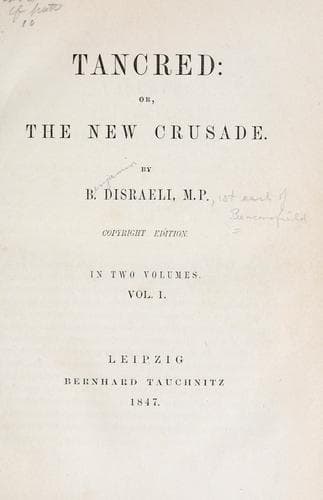
Tancred; Or, The New CrusadeDisraeli, Benjamin, Earl of Beaconsfield
ReligionJewish
Tancred; Or, The New Crusade
Disraeli, Benjamin, Earl of Beaconsfield
Christianity and other religions -- Judaism -- Fiction; Judaism -- Relations -- Christianity -- Fiction
Tancred could not bring himself to desert the only being perhaps in
England, excepting himself, whose heart was at Jerusalem; and that
being a woman! There seemed something about it unknightly, unkind and
cowardly, almost base. Lady Bertie was a heroine worthy of ancient
Christendom rather than of enlightened Europe. In the old days, truly
the good old days, when the magnetic power of Western Asia on the Gothic
races had been more puissant, her noble yet delicate spirit might have
been found beneath the walls of Ascalon or by the purple waters of
Tyre. When Tancred first met her, she was dreaming of Palestine amid her
frequent sadness; he could not, utterly void of all self-conceit as
he was, be insensible to the fact that his sympathy, founded on such
a divine congeniality, had often chased the cloud from her brow and
lightened the burthen of her drooping spirit. If she were sad before,
what would she be now, deprived of the society of the only being to whom
she could unfold the spiritual mysteries of her romantic soul? Was such
a character to be left alone in this world of slang and scrip; of coarse
motives and coarser words? Then, too, she was so intelligent and so
gentle; the only person who understood him, and never grated for an
instant on his high ideal. Her temper also was the sweetest in the
world, eminent as her generous spirit. She spoke of others with so much
kindness, and never indulged in that spirit of detraction or that love
of personal gossip which Tancred had frankly told her he abhorred.
Somehow or other it seemed that their tastes agreed on everything.
The agitated Tancred rose from the bed where the hope of slumber was
vain. The fire in his dressing-room was nearly extinguished; wrapped in
his chamber robe, he threw himself into a chair, which he drew near the
expiring embers, and sighed.
Unhappy youth! For you commences that great hallucination, which all
must prove, but which fortunately can never be repeated, and which,
in mockery, we call first love. The physical frame has its infantile
disorders; the cough which it must not escape, the burning skin which it
must encounter. The heart has also its childish and cradle malady, which
may be fatal, but which, if once surmounted, enables the patient to meet
with becoming power all the real convulsions and fevers of passion that
are the heirloom of our after-life. They, too, may bring destruction;
but, in their case, the cause and the effect are more proportioned.
The heroine is real, the sympathy is wild but at least genuine, the
catastrophe is that of a ship at sea which sinks with a rich cargo in a
noble venture.
Public-domain text, read in full here on John Shaqi.
Reviews
Reviews
No reviews yet
Be the first to share your thoughts on this work.
Elsewhere in the archive
Join the Discussion
Join the discussion
Sign in to leave a comment or review.
Sign InorCreate an account