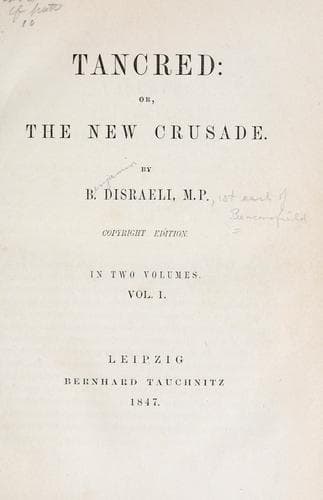
Tancred; Or, The New CrusadeDisraeli, Benjamin, Earl of Beaconsfield
ReligionJewish
Tancred; Or, The New Crusade
Disraeli, Benjamin, Earl of Beaconsfield
Christianity and other religions -- Judaism -- Fiction; Judaism -- Relations -- Christianity -- Fiction
In our relations with the softer sex it cannot be maintained that
ignorance is bliss. On the contrary, experience is the best security
for enduring love. Love at first sight is often a genial and genuine
sentiment, but first love at first sight is ever eventually branded as
spurious. Still more so is that first love which suffuses less rapidly
the spirit of the ecstatic votary, when he finds that by degrees his
feelings, as the phrase runs, have become engaged. Fondness is so new
to him that he has repaid it with exaggerated idolatry, and become
intoxicated by the novel gratification of his vanity. Little does he
suspect that all this time his seventh heaven is but the crapulence
of self-love. In these cases, it is not merely that everything is
exaggerated, but everything is factitious. Simultaneously, the imaginary
attributes of the idol disappearing, and vanity being satiated, all ends
in a crash of iconoclastic surfeit.
The embers became black, the night air had cooled the turbulent blood of
Lord Montacute, he shivered, returned to his couch, and found a deep and
invigorating repose.
The next morning, about two hours after noon, Tancred called on Lady
Bertie. As he drove up to the door, there came forth from it the
foreigner who was her companion in the city fray when Tancred first saw
her and went to her rescue. He recognised Lord Montacute, and bowed with
much ceremony, though with a certain grace and bearing. He was a man
whose wrinkled visage strangely contrasted with his still gallant
figure, scrupulously attired; a blue frock-coat with a ribboned
button-hole, a well-turned boot, hat a little too hidalgoish, but
quite new. There was something respectable and substantial about him,
notwithstanding his moustaches, and a carriage a degree too debonair for
his years. He did not look like a carbonaro or a refugee. Who could he
be?
Tancred had asked himself this question before. This was not the first
time that he had encountered this distinguished foreigner since their
first meeting. Tancred had seen him before this, quitting the door of
Lord Bertie and Bellair; had stumbled over him before this, more than
once, on the staircase; once, to his surprise, had met him as he entered
the personal saloon of Lady Bertie. As it was evident, on that occasion,
that his visit had been to the lady, it was thought necessary to say
something, and he had been called the Baron, and described, though in a
somewhat flurried and excited manner, as a particular friend, a person
in whom they had the most entire confidence, who had been most kind to
them at Paris, putting them in the way of buying the rarest china for
nothing, and who was now over here on some private business of his own,
of great importance. The Bertie and Bellairs felt immense interest in
his exertions, and wished him every success; Lord Bertie particularly.
It was not at all surprising, considering the innumerable kindnesses
they had experienced at his hands, was it?
Public-domain text, read in full here on John Shaqi.
Reviews
Reviews
No reviews yet
Be the first to share your thoughts on this work.
Elsewhere in the archive
Join the Discussion
Join the discussion
Sign in to leave a comment or review.
Sign InorCreate an account