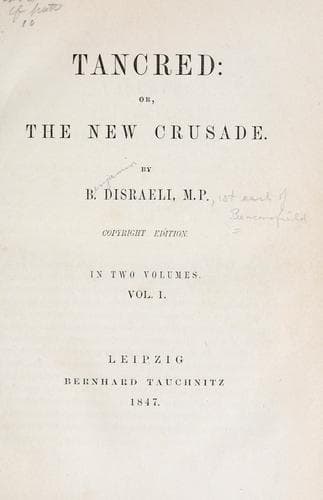
Tancred; Or, The New CrusadeDisraeli, Benjamin, Earl of Beaconsfield
ReligionJewish
Tancred; Or, The New Crusade
Disraeli, Benjamin, Earl of Beaconsfield
Christianity and other religions -- Judaism -- Fiction; Judaism -- Relations -- Christianity -- Fiction
After Easter, Parliament requiring their presence, the courtyard of one
of the few palaces in London opened, and the world learnt that the Duke
and Duchess of Bellamont had arrived at Bellamont House, from Montacute
Castle. During their stay in town, which they made as brief as they
well could, and which never exceeded three months, they gave a series
of great dinners, principally attended by noble relations and those
families of the county who were so fortunate as to have also a residence
in London. Regularly every year, also, there was a grand banquet
given to some members of the royal family by the Duke and Duchess of
Bellamont, and regularly every year the Duke and Duchess of Bellamont
had the honour of dining at the palace. Except at a ball or concert
under the royal roof, the duke and duchess were never seen anywhere
in the evening. The great ladies indeed, the Lady St. Julians and the
Marchionesses of Deloraine, always sent them invitations, though they
were ever declined. But the Bellamonts maintained a sort of
traditional acquaintance with a few great houses, either by the ties
of relationship, which, among the aristocracy, are very ramified, or
by occasionally receiving travelling magnificoes at their hospitable
castle.
To the great body, however, of what is called ‘the world,’ the world
that lives in St. James’ Street and Pall Mall, that looks out of a club
window, and surveys mankind as Lucretius from his philosophic tower; the
world of the Georges and the Jemmys; of Mr. Cassilis and Mr. Melton; of
the Milfords and the Fitz-Herons, the Berners and the Egertons, the Mr.
Ormsbys and the Alfred Mountchesneys, the Duke and Duchess of Bellamont
were absolutely unknown.
All that the world knew was, that there was a great peer who was called
Duke of Bellamont; that there was a great house in London, with a
courtyard, which bore his name; that he had a castle in the country,
which was one of the boasts of England; and that this great duke had a
duchess; but they never met them anywhere, nor did their wives and their
sisters, and the ladies whom they admired, or who admired them,
either at ball or at breakfast, either at morning dances or at evening
déjeuners. It was clear, therefore, that the Bellamonts might be very
great people, but they were not in ‘society.’
Public-domain text, read in full here on John Shaqi.
Reviews
Reviews
No reviews yet
Be the first to share your thoughts on this work.
Join the Discussion
Join the discussion
Sign in to leave a comment or review.
Sign InorCreate an account