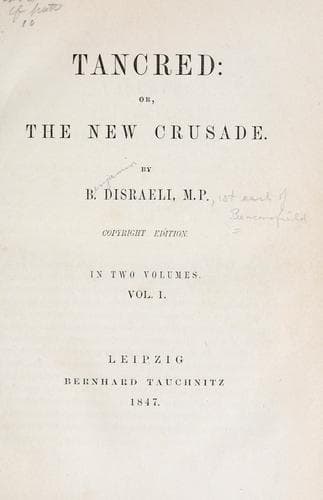
Tancred; Or, The New CrusadeDisraeli, Benjamin, Earl of Beaconsfield
ReligionJewish
Tancred; Or, The New Crusade
Disraeli, Benjamin, Earl of Beaconsfield
Christianity and other religions -- Judaism -- Fiction; Judaism -- Relations -- Christianity -- Fiction
Whatever difference of opinion may exist as to the policy pursued by
the foreign minister of England, with respect to the settlement of the
Turkish Empire in 1840-41, none can be permitted, by those, at least,
competent to decide upon such questions, as to the ability with which
that policy was accomplished. When we consider the position of the
minister at home, not only deserted by Parliament, but abandoned by his
party and even forsaken by his colleagues; the military occupation
of Syria by the Egyptians; the rabid demonstration of France; that an
accident of time or space, the delay of a month or the gathering of a
storm, might alone have baffled all his combinations, it is difficult to
fix upon a page in the history of this country which records a superior
instance of moral intrepidity. The bold conception and the brilliant
performance were worthy of Chatham; but the domestic difficulties with
which Lord Palmerston had to struggle place the exploit beyond the
happiest achievement of the elder Pitt. Throughout the memorable
conjuncture, Lord Palmerston, however, had one great advantage, which
was invisible to the millions; he was served by a most vigilant and able
diplomacy. The superiority of his information concerning the state of
Syria to that furnished to the French minister was the real means
by which he baffled the menaced legions of our neighbours. A timid
Secretary of State in the position of Lord Palmerston, even with such
advantages, might have faltered; but the weapon was placed in the hands
of one who did not shrink from its exercise, and the expulsion of
the Egyptians from Turkey remains a great historic monument alike of
diplomatic skill and administrative energy.
The rout of the Egyptians was fatal to the Emir Bescheer, and it seemed
also, for a time, to the Damascus branch of the family of Besso. But in
these days a great capitalist has deeper roots than a sovereign prince,
unless he is very legitimate. The Prince of the Mountain and his
sons were summoned from their luxurious and splendid Beteddeen to
Constantinople, where they have ever since remained prisoners. Young
Fakredeen, the moment he heard of the fall of Acre, rode out with his
falcon, as if for the pastime of a morning, and the moment he was out of
sight made for the desert, and never rested until he reached the tents
of the children of Rechab, where he placed himself under the protection
of the grandfather of Eva.
Public-domain text, read in full here on John Shaqi.
Reviews
Reviews
No reviews yet
Be the first to share your thoughts on this work.
Elsewhere in the archive
Join the Discussion
Join the discussion
Sign in to leave a comment or review.
Sign InorCreate an account