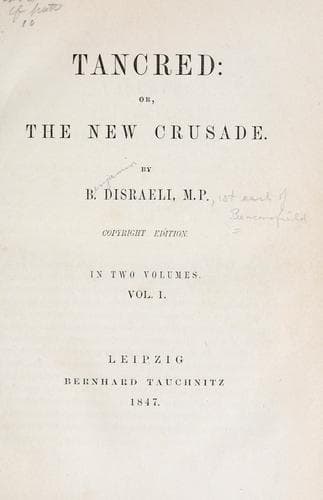
Tancred; Or, The New CrusadeDisraeli, Benjamin, Earl of Beaconsfield
ReligionJewish
Tancred; Or, The New Crusade
Disraeli, Benjamin, Earl of Beaconsfield
Christianity and other religions -- Judaism -- Fiction; Judaism -- Relations -- Christianity -- Fiction
brilliant; and finally proposed to Besso to raise a loan for the
Lebanon, ostensibly to promote the cultivation of mulberries, really to
supply arms to the discontented population who were to make Fakredeen
and Eva sovereigns of the mountain. It will have been observed, that to
supply the partially disarmed tribes of the mountain with weapons was
still, though at intervals, the great project of Fakredeen, and to
obtain the result in his present destitution of resources involved
him in endless stratagems. His success would at the same time bind the
tribes, already well affected to him, with unalterable devotion to a
chief capable of such an undeniable act of sovereignty, and of course
render them proportionately more efficient instruments in accomplishing
his purpose. It was the interest of Fakredeen that the Lebanon should be
powerful and disturbed.
Besso, who had often befriended him, and who had frequently rescued
him from the usurers of Beiroot and Sidon, lent a cold ear to these
suggestions. The great merchant was not inclined again to embark in
a political career, or pass another three or four years away from his
Syrian palaces and gardens. He had seen the most powerful head that the
East had produced for a century, backed by vast means, and after having
apparently accomplished his purpose, ultimately recoil before the
superstitious fears of Christendom, lest any change in Syria should
precipitate the solution of the great Eastern problem. He could not
believe that it was reserved for Fakredeen to succeed in that which had
baffled Mehemet Ali.
Eva took the more sanguine view that becomes youth and woman. She had
faith in Fakredeen. Though his position was not as powerful as that of
the great viceroy, it was, in her opinion, more legitimate. He seemed
indicated as the natural ruler of the mountain. She had faith, too,
in his Arabian origin. With Eva, what is called society assumed the
character of a continual struggle between Asia and the North. She
dreaded the idea that, after having escaped the crusaders, Syria should
fall first under the protection, and then the colonisation of some
European power. A link was wanted in the chain of resistance which
connected the ranges of Caucasus with the Atlas. She idealised her
foster-brother into a hero, and saw his standard on Mount Lebanon, the
beacon of the oriental races, like the spear of Shami, or the pavilion
of Abd-el-Kader. Eva had often influenced her father for the advantage
of Fakredeen, but at last even Eva felt that she should sue in vain.
A year before, involved in difficulties which it seemed no combination
could control, and having nearly occasioned the occupation of Syria by
a united French and English force, Fakredeen burst out a-cry-ing like
a little boy, and came whimpering to Eva, as if somebody had broken his
toy or given him a beating. Then it was that Eva had obtained for him
a final assistance from her father, the condition being, that this
application should be the last.
Public-domain text, read in full here on John Shaqi.
Reviews
Reviews
No reviews yet
Be the first to share your thoughts on this work.
Elsewhere in the archive
Join the Discussion
Join the discussion
Sign in to leave a comment or review.
Sign InorCreate an account