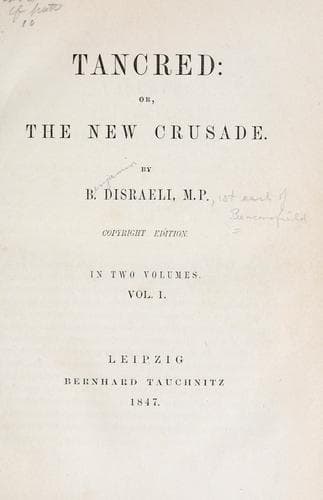
Tancred; Or, The New CrusadeDisraeli, Benjamin, Earl of Beaconsfield
ReligionJewish
Tancred; Or, The New Crusade
Disraeli, Benjamin, Earl of Beaconsfield
Christianity and other religions -- Judaism -- Fiction; Judaism -- Relations -- Christianity -- Fiction
Though it was his profession and his pride to simulate and to dissemble,
he had a native ingenuousness which was extremely awkward and very
surprising, for, the moment he was intimate with you, he told you
everything. Though he intended to make a person his tool, and often
succeeded, such was his susceptibility, and so strong were his
sympathetic qualities, that he was perpetually, without being aware of
it, showing his cards. The victim thought himself safe, but the teeming
resources of Fakredeen were never wanting, and some fresh and brilliant
combination, as he styled it, often secured the prey which so heedlessly
he had nearly forfeited. Recklessness with him was a principle of
action. He trusted always to his fertile expedients if he failed, and
ran the risk in the meanwhile of paramount success, the fortune of those
who are entitled to be rash. With all his audacity, which was nearly
equal to his craft, he had no moral courage; and, if affairs went wrong,
and, from some accident, exhaustion of the nervous system, the weather,
or some of those slight causes which occasionally paralyse the creative
mind, he felt without a combination, he would begin to cry like a
child, and was capable of any action, however base and humiliating, to
extricate himself from the impending disaster.
Fakredeen had been too young to have fatally committed himself during
the Egyptian occupation. The moment he found that the Emir Bescheer and
his sons were prisoners at Constantinople, he returned to Syria, lived
quietly at his own castle, affected popularity among the neighbouring
chieftains, who were pleased to see a Shehaab among them, and showed
himself on every occasion a most loyal subject of the Porte. At
seventeen years of age, Fakredeen was at the head of a powerful party,
and had opened relations with the Divan. The Porte looked upon him with
confidence, and although they intended, if possible, to govern Lebanon
in future themselves, a young prince of a great house, and a young
prince so perfectly free from all disagreeable antecedents, was not to
be treated lightly. All the leaders of all the parties of the mountain
frequented the castle of Fakredeen, and each secretly believed that the
prince was his pupil and his tool. There was not one of these men,
grey though some of them were in years and craft, whom the innocent and
ingenuous Fakredeen did not bend as a nose of wax, and, when Adam Besso
returned to Syria in ‘43, he found his foster-child by far the most
considerable person in the country, and all parties amid their doubts
and distractions looking up to him with hope and confidence. He was then
nineteen years of age, and Eva was sixteen. Fakredeen came instantly
to Damascus to welcome them, hugged Besso, wept like a child over his
sister, sat up the whole night on the terrace of their house smoking
his nargileh, and telling them all his secrets without the slightest
reserve: the most shameful actions of his career as well as the most
Public-domain text, read in full here on John Shaqi.
Reviews
Reviews
No reviews yet
Be the first to share your thoughts on this work.
Elsewhere in the archive
Join the Discussion
Join the discussion
Sign in to leave a comment or review.
Sign InorCreate an account