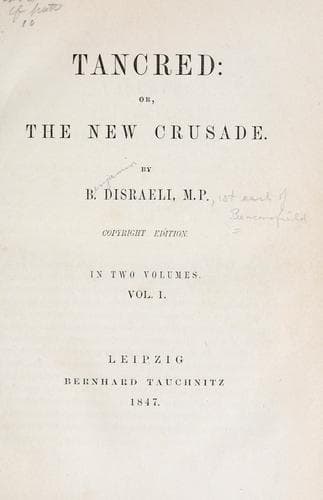
Tancred; Or, The New CrusadeDisraeli, Benjamin, Earl of Beaconsfield
ReligionJewish
Tancred; Or, The New Crusade
Disraeli, Benjamin, Earl of Beaconsfield
Christianity and other religions -- Judaism -- Fiction; Judaism -- Relations -- Christianity -- Fiction
About an hour after leaving Bethlehem, in a secluded valley, is one of
the few remaining public works of the great Hebrew Kings, It is in every
respect worthy of them. I speak of those colossal reservoirs cut out
of the native rock and fed by a single spring, discharging their waters
into an aqueduct of perforated stone, which, until a comparatively
recent period, still conveyed them to Jerusalem. They are three in
number, of varying lengths from five to six hundred feet, and almost
as broad; their depth, still undiscovered. They communicate with each
other, so that the water of the uppermost reservoir, flowing through the
intermediate one, reached the third, which fed the aqueduct. They are
lined with a hard cement like that which coats the pyramids, and which
remains uninjured; and it appears that hanging gardens once surrounded
them. The Arabs still call these reservoirs the pools of Solomon, nor is
there any reason to doubt the tradition. Tradition, perhaps often more
faithful than written documents, is a sure and almost infallible guide
in the minds of the people where there has been no complicated variety
of historic incidents to confuse and break the chain of memory; where
their rare revolutions have consisted of an eruption once in a thousand
years into the cultivated world; where society has never been broken
up, but their domestic manners have remained the same; where, too, they
revere truth, and are rigid in its oral delivery, since that is their
only means of disseminating knowledge.
There is no reason to doubt that these reservoirs were the works
of Solomon. This secluded valley, then, was once the scene of his
imaginative and delicious life. Here were his pleasure gardens; these
slopes were covered with his fantastic terraces, and the high places
glittered with his pavilions. The fountain that supplied these treasured
waters was perhaps the ‘sealed fountain,’ to which he compared his
bride; and here was the garden palace where the charming Queen of Sheba
vainly expected to pose the wisdom of Israel, as she held at a distance
before the most dexterous of men the two garlands of flowers, alike in
form and colour, and asked the great king, before his trembling court,
to decide which of the wreaths was the real one.
They are gone, they are vanished, these deeds of beauty and these words
of wit! The bright and glorious gardens of the tiaraed poet and the
royal sage, that once echoed with his lyric voice, or with the startling
truths of his pregnant aphorisms, end in this wild and solitary valley,
in which with folded arms and musing eye of long abstraction, Tancred
halts in his ardent pilgrimage, nor can refrain from asking himself,
‘Can it, then, be true that all is vanity?’
Public-domain text, read in full here on John Shaqi.
Reviews
Reviews
No reviews yet
Be the first to share your thoughts on this work.
Elsewhere in the archive
Join the Discussion
Join the discussion
Sign in to leave a comment or review.
Sign InorCreate an account