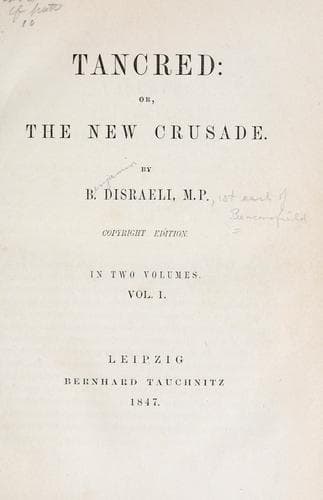
Tancred; Or, The New CrusadeDisraeli, Benjamin, Earl of Beaconsfield
ReligionJewish
Tancred; Or, The New Crusade
Disraeli, Benjamin, Earl of Beaconsfield
Christianity and other religions -- Judaism -- Fiction; Judaism -- Relations -- Christianity -- Fiction
Why, what, is this desolation? Why are there no more kings whose words
are the treasured wisdom of countless ages, and the mention of whose
name to this moment thrills the heart of the Oriental, from the waves of
the midland ocean to the broad rivers of the farthest Ind? Why are there
no longer bright-witted queens to step out of their Arabian palaces
and pay visits to the gorgeous ‘house of the forest of Lebanon,’ or
to where Baalbec, or Tadmor in the wilderness, rose on those plains now
strewn with the superb relics of their inimitable magnificence?
And yet some flat-nosed Frank, full of bustle and puffed up with
self-conceit (a race spawned perhaps in the morasses of some Northern
forest hardly yet cleared), talks of Progress! Progress to what, and
from whence? Amid empires shrivelled into deserts, amid the wrecks of
great cities, a single column or obelisk of which nations import for
the prime ornament of their mud-built capitals, amid arts forgotten,
commerce annihilated, fragmentary literatures and populations destroyed,
the European talks of progress, because, by an ingenious application
of some scientific acquirements, he has established a society which has
mistaken comfort for civilisation.
The soft beam of the declining sun fell upon a serene landscape; gentle
undulations covered with rich shrubs or highly cultivated corn-fields
and olive groves; sometimes numerous flocks; and then vineyards
fortified with walls and with watch-towers, as in the time of David,
whose city Tancred was approaching. Hebron, too, was the home of the
great Sheikh Abraham; and the Arabs here possess his tomb, which no
Christian is permitted to visit. It is strange and touching, that the
children of Ishmael should have treated the name and memory of
the Sheikh Abraham with so much reverence and affection. But the
circumstance that he was the friend of Allah appears with them entirely
to have outweighed the recollection of his harsh treatment of their
great progenitor. Hebron has even lost with them its ancient Judæan
name, and they always call it, in honour of the tomb of the Sheikh, the
‘City of a Friend.’
About an hour after Hebron, in a fair pasture, and near an olive grove,
Tancred pitched his tent, prepared on the morrow to quit the land of
promise, and approach that ‘great and terrible wilderness where there
was no water.’
‘The children of Israel,’ as they were called according to the custom
then and now universally prevalent among the Arabian tribes (as, for
example, the Beni Kahtan, Beni Kelb, Beni Salem, Beni Sobh, Beni Ghamed,
Beni Seydan, Beni Ali, Beni Hateym, all adopting for their description
the name of their founder), the ‘children of Israel’ were originally a
tribe of Arabia Petrasa. Under the guidance of sheikhs of great ability,
they emerged from their stony wilderness and settled on the Syrian
border.
Public-domain text, read in full here on John Shaqi.
Reviews
Reviews
No reviews yet
Be the first to share your thoughts on this work.
Elsewhere in the archive
Join the Discussion
Join the discussion
Sign in to leave a comment or review.
Sign InorCreate an account