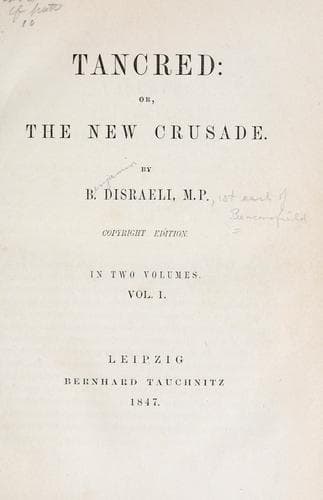
Tancred; Or, The New CrusadeDisraeli, Benjamin, Earl of Beaconsfield
ReligionJewish
Tancred; Or, The New Crusade
Disraeli, Benjamin, Earl of Beaconsfield
Christianity and other religions -- Judaism -- Fiction; Judaism -- Relations -- Christianity -- Fiction
Sometimes the land is cleared, and he finds himself by the homestead
of a forest farm, and remarks the buildings, distinguished not only by
their neatness, but the propriety of their rustic architecture. Still
advancing, the deer become rarer, and the road is formed by an avenue
of chestnuts; the forest, on each side, being now transformed into
vegetable gardens. The stir of the population is soon evident. Persons
are moving to and fro on the side path of the road. Horsemen and carts
seem returning from market; women with empty baskets, and then the rare
vision of a stage-coach. The postilion spurs his horses, cracks his
whip, and dashes at full gallop into the town of Montacute, the capital
of the forest.
It is the prettiest little town in the world, built entirely of hewn
stone, the well-paved and well-lighted streets as neat as a Dutch
village. There are two churches: one of great antiquity, the other
raised by the present duke, but in the best style of Christian
architecture. The bridge that spans the little but rapid river Belle,
is perhaps a trifle too vast and Roman for its site; but it was built
by the first duke of the second dynasty, who was always afraid of
underbuilding his position. The town was also indebted to him for their
hall, a Palladian palace. Montacute is a corporate town, and, under
the old system, returned two members to Parliament. The amount of
its population, according to the rule generally observed, might have
preserved it from disfranchisement, but, as every house belonged to
the duke, and as he was what, in the confused phraseology of the
revolutionary war, was called a Tory, the Whigs took care to put
Montacute in Schedule A.
The town-hall, the market-place, a literary institution, and the new
church, form, with some good houses of recent erection, a handsome
square, in which there is a fountain, a gift to the town from the
present duchess.
At the extremity of the town, the ground rises, and on a woody steep,
which is in fact the termination of a long range of tableland, may be
seen the towers of the outer court of Montacute Castle. The principal
building, which is vast and of various ages, from the Plantagenets to
the Guelphs, rises on a terrace, from which, on the side opposite to the
town, you descend into a well-timbered inclosure, called the Home Park.
Further on, the forest again appears; the deer again crouch in their
fern, or glance along the vistas; nor does this green domain terminate
till it touches the vast and purple moors that divide the kingdoms of
Great Britain.
It was on an early day of April that the duke was sitting in his private
room, a pen in one hand, and looking up with a face of pleasurable
emotion at his wife, who stood by his side, her right arm sometimes on
the back of his chair, and sometimes on his shoulder, while with her
other hand, between the intervals of speech, she pressed a handkerchief
to her eyes, bedewed with the expression of an affectionate excitement.
Public-domain text, read in full here on John Shaqi.
Reviews
Reviews
No reviews yet
Be the first to share your thoughts on this work.
Join the Discussion
Join the discussion
Sign in to leave a comment or review.
Sign InorCreate an account