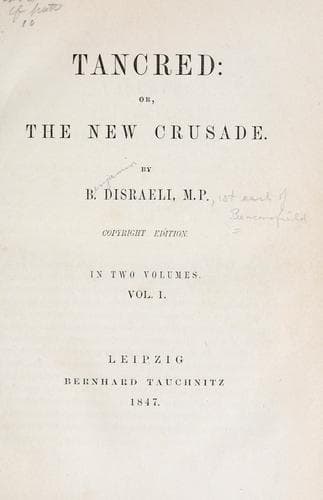
Tancred; Or, The New CrusadeDisraeli, Benjamin, Earl of Beaconsfield
ReligionJewish
Tancred; Or, The New Crusade
Disraeli, Benjamin, Earl of Beaconsfield
Christianity and other religions -- Judaism -- Fiction; Judaism -- Relations -- Christianity -- Fiction
The speaker having covered himself, the band again formed and passed
the window of Sidonia’s hotel, followed by a stream of idle amateurs,
animated by the martial strain, and attracted by the pleasure of hearing
another fine performance at the next quarter of the town, where the
Baroni family might halt to announce the impending amusements of the
evening.
The moon was beginning to glitter, when Sidonia threw his cloak around
him, and asked the way to the Auberge of St. Nicholas. It was a large,
ungainly, whitewashed house, at the extremity of a suburb where the
straggling street nearly ceased, and emptied itself into what in England
would have been called a green. The many windows flared with lights, the
doorway was filled with men smoking, and looking full of importance, as
if, instead of being the usual loungers of the tavern, they were about
to perform a principal part in the exhibition; they made way with
respectful and encouraging ceremony to any one who entered to form part
of the audience, and rated with sharp words, and sometimes a ready cuff,
a mob of little boys who besieged the door, and implored every one who
entered to give them tickets to see the Crucifixion. ‘It’s the last
piece,’ they perpetually exclaimed, ‘and we may come in for five sous a
head.’
Sidonia mounted the staircase, and, being a suitor for a ticket for the
principal seats, was received with a most gracious smile by a pretty
woman, fair-faced and arch, with a piquant nose and a laughing blue
eye, who sat at the door of the room. It was a long and rather narrow
apartment; at the end, a stage of rough planks, before a kind of
curtain, the whole rudely but not niggardly lighted. Unfortunately for
the Baroni family, Sidonia found himself the only first-class spectator.
There was a tolerable sprinkling of those who paid half a franc for
their amusement. These were separated from the first row, which Sidonia
alone was to occupy; in the extreme distance was a large space not
fitted up with benches, where the miscellaneous multitude, who could
summon up five sous apiece later in the evening, to see the Crucifixion,
were to be stowed.
‘It hardly pays the lights,’ said the pretty woman at the door. ‘We have
not had good fortune in this town. It seems hard, when there is so much
for the money, and the children take such pains in going the rounds in
the morning.’
‘And you are Madame Baroni?’ said Sidonia.
‘Yes; I am the mother,’ she replied.
‘I should have thought you had been their sister,’ said Sidonia.
‘My eldest son is fifteen! I often wish that he was anything else but
what he is, but we do not like to separate. We are all one family, sir,
and that makes us bear many things.’
‘Well, I think I know a way to increase your audience,’ said Sidonia.
‘Indeed! I am sure it is very kind of you to say so much; we have not
met with a gentleman like you the whole time we have been here.’
Public-domain text, read in full here on John Shaqi.
Reviews
Reviews
No reviews yet
Be the first to share your thoughts on this work.
Elsewhere in the archive
Join the Discussion
Join the discussion
Sign in to leave a comment or review.
Sign InorCreate an account