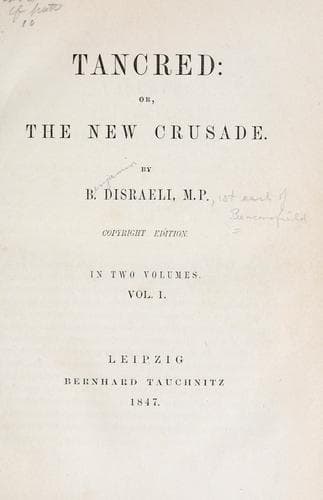
Tancred; Or, The New CrusadeDisraeli, Benjamin, Earl of Beaconsfield
ReligionJewish
Tancred; Or, The New Crusade
Disraeli, Benjamin, Earl of Beaconsfield
Christianity and other religions -- Judaism -- Fiction; Judaism -- Relations -- Christianity -- Fiction
‘As this feat pleases you,’ said the father, ‘and as we have a gentleman
here to-night who has proved himself a liberal patron of artists, I will
show you something that I rarely exhibit; I will hold the whole of
the Baroni family with my two hands;’ and hereupon addressing some
stout-looking fellows among his audience, he begged them to come forward
and hold each end of a plank that was leaning against the wall, one
which had not been required for the quickly-constructed stage. This they
did with some diffidence, and with that air of constraint characteristic
of those who have been summoned from a crowd to perform something which
they do not exactly comprehend.
‘Be not afraid, my good friends,’ said Baroni to them, as Francis
lightly sprang on one end of the plank, and Josephine on the other; then
Alfred and Adelaide skipped up together at equal distances; so that the
four children were now standing in attitude upon the same basis, which
four stout men endeavoured, with difficulty, to keep firm. At that
moment Madame Baroni, with the two young children, came from behind the
curtain, and vaulted exactly on the middle of the board, so that the
bold Michel on the one side, and the demure Carlotta on the other,
completed the group. ‘Thank you, my friends,’ said Baroni, slipping
under the plank, which was raised to a height which just admitted him to
pass under it, ‘I will release you,’ and with his outstretched hands he
sustained the whole burthen, the whole of the Baroni family supported by
the father.
After this there was a pause of a few minutes, the stage was cleared and
Baroni, in a loose great-coat, appeared at its side with a violin. He
played a few bars, then turning to the audience, said with the same
contemptuous expression, which always distinguished him when he
addressed them, ‘Now you are going to hear a scene from a tragedy of the
great Racine, one of the greatest tragedy writers that ever existed, if
you may never have heard him; but if you were at Paris, and went to the
great theatre, you would find that what I am telling you is true.’ And
Josephine advanced, warmly cheered by the spectators, who thought that
they were going to have some more tumbling. She advanced, however, as
Andromache. It seemed to Sidonia that he had never listened to a voice
more rich and passionate, to an elocution more complete; he gazed with
admiration on her lightning glance and all the tumult of her noble brow.
As she finished, he applauded her with vehemence. He was standing near
to her father leaning against the wall.
‘Your daughter is a great actress,’ he said to Baroni.
‘I sometimes think so,’ said the father, turning round with some
courtesy to Sidonia, whom he recognised as the liberal stranger who had
so kindly increased his meagre audience; ‘I let her do this to please
herself. She is a good girl, but very few of the respectable savages
here speak French. However, she likes it. Adelaide is now going to sing;
that will suit them better.’
Public-domain text, read in full here on John Shaqi.
Reviews
Reviews
No reviews yet
Be the first to share your thoughts on this work.
Elsewhere in the archive
Join the Discussion
Join the discussion
Sign in to leave a comment or review.
Sign InorCreate an account