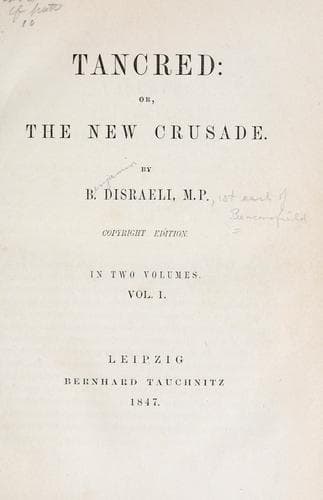
Tancred; Or, The New CrusadeDisraeli, Benjamin, Earl of Beaconsfield
ReligionJewish
Tancred; Or, The New Crusade
Disraeli, Benjamin, Earl of Beaconsfield
Christianity and other religions -- Judaism -- Fiction; Judaism -- Relations -- Christianity -- Fiction
‘He has been so much away from us these last three years,’ said the
duchess in a tone of great depression, ‘and they are such important
years in the formation of character! But Mr. Bernard, he ought to have
been aware of all this; he ought to have known what was passing through
his pupil’s mind; he ought to have warned us. Let us speak to him;
let us speak to him at once. Ring, my dear George, and request the
attendance of Mr. Bernard.’
That gentleman, who was in the library, kept them waiting but a few
minutes. As he entered the room, he perceived, by the countenances
of his noble patrons, that something remarkable, and probably not
agreeable, had occurred. The duke opened the case to Mr. Bernard with
calmness; he gave an outline of the great catastrophe; the duchess
filled up the parts, and invested the whole with a rich and even
terrible colouring.
Nothing could exceed the astonishment of the late private tutor of
Lord Montacute. He was fairly overcome; the communication itself was
startling, the accessories overwhelmed him. The unspoken reproaches
that beamed from the duke’s mild eye; the withering glance of maternal
desolation that met him from the duchess; the rapidity of her anxious
and agitated questions; all were too much for the simple, though
correct, mind of one unused to those passionate developments which are
commonly called scenes. All that Mr. Bernard for some time could do
was to sit with his eyes staring and mouth open, and repeat, with a
bewildered air, ‘The Holy Land, the Holy Sepulchre!’ No, most certainly
not; most assuredly; never in any way, by any word or deed, had Lord
Montacute ever given him reason to suppose or imagine that his lordship
intended to make a pilgrimage to the Holy Sepulchre, or that he was
influenced by any of those views and opinions which he had so strangely
and so uncompromisingly expressed to his father.
‘But, Mr. Bernard, you have been his companion, his instructor, for many
years,’ continued the duchess, ‘for the last three years especially,
years so important in the formation of character. You have seen much
more of Montacute than we have. Surely you must have had some idea of
what was passing in his mind; you could not help knowing it; you ought
to have known it; you ought to have warned, to have prepared us.’
‘Madam,’ at length said Mr. Bernard, more collected, and feeling the
necessity and excitement of self-vindication, ‘Madam, your noble son,
under my poor tuition, has taken the highest honours of his university;
his moral behaviour during that period has been immaculate; and as for
his religious sentiments, even this strange scheme proves that they are,
at any rate, of no light and equivocal character.’
‘To lose such a son!’ exclaimed the duchess, in a tone of anguish, and
with streaming eyes.
Public-domain text, read in full here on John Shaqi.
Reviews
Reviews
No reviews yet
Be the first to share your thoughts on this work.
Join the Discussion
Join the discussion
Sign in to leave a comment or review.
Sign InorCreate an account