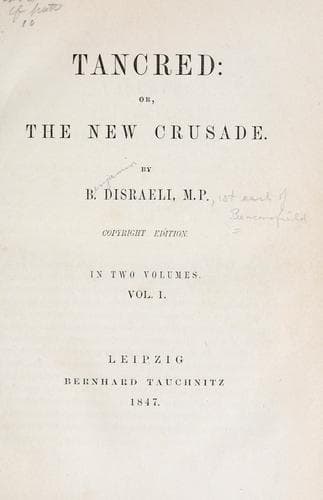
Tancred; Or, The New CrusadeDisraeli, Benjamin, Earl of Beaconsfield
ReligionJewish
Tancred; Or, The New Crusade
Disraeli, Benjamin, Earl of Beaconsfield
Christianity and other religions -- Judaism -- Fiction; Judaism -- Relations -- Christianity -- Fiction
When the English public, therefore, were assured by their
co-religionists on the other side of St. George’s Channel, that at last
the good work was doing; that the flame spread, even rapidly; that
not only parishes but provinces were all agog, and that both town and
country were quite in a heat of proselytism, they began to believe that
at last the scarlet lady was about to be dethroned; they loosened
their purse-strings; fathers of families contributed their zealous five
pounds, followed by every other member of the household, to the babe
in arms, who subscribed its fanatical five shillings. The affair
looked well. The journals teemed with lists of proselytes and cases of
conversion; and even orderly, orthodox people, who were firm in their
own faith, but wished others to be permitted to pursue their errors in
peace, began to congratulate each other on the prospect of our at last
becoming a united Protestant people.
In the blaze and thick of the affair, Irish Protestants jubilant, Irish
Papists denouncing the whole movement as fraud and trumpery, John Bull
perplexed, but excited, and still subscribing, a young bishop rose in
his place in the House of Lords, and, with a vehemence there unusual,
declared that he saw ‘the finger of God in this second Reformation,’
and, pursuing the prophetic vein and manner, denounced ‘woe to those who
should presume to lift up their hands and voices in vain and impotent
attempts to stem the flood of light that was bursting over Ireland.’
In him, who thus plainly discerned ‘the finger of God’ in transactions
in which her family and feelings were so deeply interested, the young
and enthusiastic Duchess of Bellamont instantly recognised the ‘man of
God;’ and from that moment the right reverend prelate became, in all
spiritual affairs, her infallible instructor, although the impending
second Reformation did chance to take the untoward form of the
emancipation of the Roman Catholics, followed in due season by the
destruction of Protestant bishoprics, the sequestration of Protestant
tithes, and the endowment of Maynooth.
In speculating on the fate of public institutions and the course of
public affairs, it is important that we should not permit our attention
to be engrossed by the principles on which they are founded and the
circumstances which they present, but that we should also remember
how much depends upon the character of the individuals who are in the
position to superintend or to direct them.
Public-domain text, read in full here on John Shaqi.
Reviews
Reviews
No reviews yet
Be the first to share your thoughts on this work.
Join the Discussion
Join the discussion
Sign in to leave a comment or review.
Sign InorCreate an account