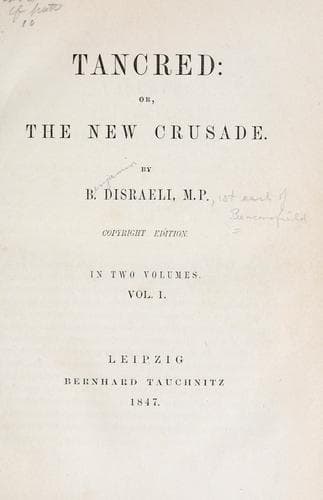
Tancred; Or, The New CrusadeDisraeli, Benjamin, Earl of Beaconsfield
ReligionJewish
Tancred; Or, The New Crusade
Disraeli, Benjamin, Earl of Beaconsfield
Christianity and other religions -- Judaism -- Fiction; Judaism -- Relations -- Christianity -- Fiction
‘Something, but chiefly for show, which I do not care about; but I mean
to get away, and refit, if necessary, at Gibraltar. I must go.’
‘Well, if you must go,’ said his lordship, and then he added, ‘and in
such a hurry; let me see. You want a firstrate managing man, used to the
East, and letters, and money, and advice. Hem! You don’t know Sidonia?’
‘Not at all.’
‘He is the man to get hold of, but that is so difficult now. He never
goes anywhere. Let me see, this is Monday; to-morrow is post-day, and
I dine with him alone in the City. Well, you shall hear from me on
Wednesday morning early, about everything; but I would not write to the
colonel and his friends just yet.’
CHAPTER XVI.
_Tancred Rescues a Lady in Distress_
THAT is most striking in London is its vastness. It is the illimitable
feeling that gives it a special character. London is not grand. It
possesses only one of the qualifications of a grand city, size; but it
wants the equally important one, beauty. It is the union of these two
qualities that produced the grand cities, the Romes, the Babylons,
the hundred portals of the Pharaohs; multitudes and magnificence; the
millions influenced by art. Grand cities are unknown since the beautiful
has ceased to be the principle of invention. Paris, of modern capitals,
has aspired to this character; but if Paris be a beautiful city, it
certainly is not a grand one; its population is too limited, and, from
the nature of their dwellings, they cover a comparatively small space.
Constantinople is picturesque; nature has furnished a sublime site, but
it has little architectural splendour, and you reach the environs with a
fatal facility. London overpowers us with its vastness.
Place a Forum or an Acropolis in its centre, and the effect of the
metropolitan mass, which now has neither head nor heart, instead of
being stupefying, would be ennobling. Nothing more completely represents
a nation than a public building. A member of Parliament only represents,
at the most, the united constituencies: but the Palace of the Sovereign,
a National Gallery, or a Museum baptised with the name of the country,
these are monuments to which all should be able to look up with pride,
and which should exercise an elevating influence upon the spirit of the
humblest. What is their influence in London? Let us not criticise what
all condemn. But how remedy the evil? What is wanted in architecture,
as in so many things, is a man. Shall we find a refuge in a Committee of
Taste? Escape from the mediocrity of one to the mediocrity of many? We
only multiply our feebleness, and aggravate our deficiencies. But one
suggestion might be made. No profession in England has done its duty
until it has furnished its victim. The pure administration of justice
dates from the deposition of Macclesfield. Even our boasted navy never
achieved a great victory until we shot an admiral. Suppose an architect
were hanged? Terror has its inspiration as well as competition.
Public-domain text, read in full here on John Shaqi.
Reviews
Reviews
No reviews yet
Be the first to share your thoughts on this work.
Elsewhere in the archive
Join the Discussion
Join the discussion
Sign in to leave a comment or review.
Sign InorCreate an account